DNA Discovery History
Unlocking the building blocks of life.
Development of the Egg Incubator
0001-01-01An ancient yet continually refined invention that revolutionized poultry farming by artificially incubating eggs.

Galileo's Microscope Gift to Federico Cesi
1624-09-01Galileo gifted a sophisticated compound microscope to Federico Cesi, president of the Accademia dei Lincei, which coined the instrument's name.

Robert Hooke Appointed Curator of Experiments for the Royal Society
1662-11-12The Royal Society snagged a genius! Robert Hooke was officially appointed their Curator of Experiments, setting the stage for scientific fireworks.

Robert Hooke Elected Fellow of the Royal Society
1663-06-03The scientific titan Robert Hooke officially joined the cool kids' club, becoming a Fellow of the Royal Society!

Robert Hooke Receives Royal Society Salary as Curator of Experiments
1664-07-01In a move that cemented scientific history, Robert Hooke finally got paid to be the Royal Society's resident mad scientist (er, Curator of Experiments)!

Robert Hooke's Landmark Publication: Micrographia
1665-01-01Robert Hooke's *Micrographia* dropped in 1665, blowing minds and revealing a stunning hidden world through the microscope!

First Successful Vaccine Demonstrated
1796-05-14Edward Jenner uses a cow to defeat a killer.
Edward Jenner noticed that milkmaids who caught cowpox never seemed to get smallpox. In a move that would definitely not pass a modern ethics board, he decided to test his theory by infecting an eight-year-old boy with cowpox and then exposing him to smallpox.
Fortunately for the boy (and humanity), it worked. Jenner had invented the first vaccine (from ‘vacca,’ the Latin word for cow). He paved the way for the eventual eradication of one of history’s greatest plagues. Thanks, cows! 🐄

Publication of Frankenstein; or, The Modern Prometheus
1818-01-01Mary Shelley's groundbreaking novel 'Frankenstein' is anonymously published, sparking eternal debates on science, creation, and responsibility.

Darwin Is Invited Aboard HMS Beagle as Ship's Naturalist
1831-08-29A single invitation letter turned a 22-year-old clergyman-in-training into the founder of evolutionary biology.

Charles Darwin first inspects HMS Beagle
1831-09-11The fateful first encounter between Charles Darwin and the ship that would carry him to scientific immortality.

The Grand Finale of Darwin's Epic Voyage
1836-10-02After nearly five years circumnavigating the globe, Charles Darwin's transformative journey aboard HMS Beagle comes to an end, paving the way for revolutionary ideas!

The Opening of the First Public Aquarium
1853-01-01London's Regent's Park unveiled the world's first public aquarium, inviting Victorians to gaze into the mysterious underwater world.

Publication of 'On the Origin of Species'
1859-11-24Charles Darwin explains why we're all here, and people have thoughts about it.
In 1859, Charles Darwin finally published his theory of natural selection after sitting on it for 20 years. He argued that species aren’t fixed, but change over time based on who survives and reproduces.
It was a simple idea that explained the incredible diversity of life on Earth. It also challenged centuries of religious and scientific dogma, making Darwin one of the most controversial figures of his time. He didn’t just find a new fact; he found a new way to see everything. We’re all just very successful mutants. 🐒

Publication of the Theory of Evolution by Natural Selection
1859-11-24Charles Darwin and Alfred Russel Wallace's groundbreaking idea that all life shares a common ancestor and evolves through natural selection.

Publication of 'The Descent of Man' by Charles Darwin
1871-02-24Darwin's mic drop, Part 2: Human evolution, finally put into print.

Scientific Recognition of Fingerprint Uniqueness
1880-10-28Henry Faulds' scientific observations in 1880 highlighted the unique and enduring nature of fingerprints, proposing their use in forensic identification.

First Dedicated U.S. Research Institute Building
1890-01-01Bricks for Brains: America's First Dedicated Science Den Opens!

Discovery of Human Blood Groups
1901-01-01Karl Landsteiner finds out why some blood transfusions kill and others save.
Before 1901, getting a blood transfusion was a 50/50 gamble. Karl Landsteiner figured out why: not all blood is the same. He identified the A, B, and O groups.
He realized that mixing incompatible blood types causes the red cells to clump together, which is bad news for the patient. His discovery made blood transfusions safe and routine, saving countless lives in surgery and on the battlefield. He won a Nobel Prize for proving that we’re all different on the inside, specifically in our veins. 🩸

Ivan Pavlov Presents His Findings on Classical Conditioning
1903-04-01Pavlov rings a bell and makes everyone realize how predictable we are.
Ivan Pavlov was studying the digestive systems of dogs when he noticed something weird: the dogs started salivating before they even saw the food. They were reacting to the sound of the lab assistant’s footsteps.
He started ringing a bell before feeding them, and soon, the bell alone was enough to make them drool. This ‘classical conditioning’ showed that behavior can be learned through association. It’s the reason you reach for your phone when you hear a notification sound, even if it’s not yours. We’re all just Pavlov’s dogs with better gadgets. 🔔

First Successful Use of Insulin on a Human Patient
1922-01-11A 14-year-old boy gets a second chance at life thanks to a new hormone.
Before 1922, a diagnosis of Type 1 diabetes was essentially a death sentence. But in Toronto, Frederick Banting and Charles Best managed to isolate insulin from the pancreas.
Their first patient, 14-year-old Leonard Thompson, was near death. After receiving the insulin, his blood sugar dropped and he regained his strength. It was a true medical miracle. Banting and his team sold the patent for just $1, wanting the medicine to be available to everyone. It remains one of the most significant moments in medical history. 💉

The Scopes 'Monkey' Trial Begins in Dayton, Tennessee
1925-07-10A small-town substitute teacher was put on trial for teaching evolution, and the case became a national media circus about science versus scripture.

The Agricultural Revolution of Hybrid Seed Corn
1926-01-01Corn gets a glow-up! Hybrid seeds transform farming, turning everyday maize into a high-yielding, super-resilient crop sensation.

Discovery of Penicillin
1928-09-28Alexander Fleming finds a miracle in a moldy petri dish.
Alexander Fleming wasn’t trying to change the world in 1928; he was just a bit messy. He went on vacation and left some petri dishes out. When he came back, he found a mold called Penicillium notatum had started killing his bacteria cultures.
Instead of throwing it away, he took a closer look. He’d found the world’s first true antibiotic. It took a few more years and some help from other scientists to make it a medicine, but Fleming’s ‘mold juice’ has since saved millions of lives. Cleanliness is next to godliness, but messiness is occasionally next to genius. 🧫

Commercialization of Quick-Frozen Fish
1930-01-01Clarence Birdseye revolutionized food preservation by popularizing quick-frozen fish, forever changing our diets.

Ernst Ruska and Max Knoll Build the First Electron Microscope
1931-01-01The Electron Microscope: Peering into the tiny universe with beams of electrons, not light!

Birth of the Dionne Quintuplets
1934-05-28The world held its breath as the first known surviving quintuplets, the Dionne sisters, arrived in rural Canada!

First Modern Coelacanth Discovered
1938-12-23A "living fossil" surfaces off the coast of South Africa, stunning scientists and rewriting textbooks on fish evolution.

Discovery of Penicillin's Structure Using X-ray Crystallography
1945-01-01Dorothy Hodgkin cracks the code of the miracle drug.
Dorothy Hodgkin used X-ray crystallography to determine the exact three-dimensional arrangement of atoms in penicillin.
It was a massive puzzle that took years to solve. Knowing the structure allowed chemists to create synthetic versions of the drug and develop new, even better antibiotics. Hodgkin later solved the structures of Vitamin B12 and insulin, proving that she was the master of seeing the invisible architecture of life. 🔬

Albert II Becomes First Primate in Space
1949-06-14A truly monkey business! Albert II, a rhesus macaque, became the first primate to reach space, paving the way for human exploration.

Discovery of the DNA Double Helix
1953-02-28The spiral secret of life unwound, revealing DNA's elegant double helix structure!

Discovery of the Double-Helix Structure of DNA Published
1953-04-25Watson and Crick find the spiral staircase of life.
In 1953, James Watson and Francis Crick walked into a pub in Cambridge and announced they’d found ’the secret of life.’ They had finally figured out that DNA is shaped like a double helix.
They couldn’t have done it without the crucial X-ray data from Rosalind Franklin, whose contribution was famously under-recognized at the time. The structure explained how life stores and copies information, turning biology into an information science. It turns out we’re all just very complex, self-replicating recipes. 🧬

Discovery of REM Sleep
1953-09-04Scientists find out that your brain is wide awake while you're fast asleep.
Eugene Aserinsky and Nathaniel Kleitman noticed that at certain times during the night, a sleeper’s eyes would dart back and forth under their eyelids. They called it Rapid Eye Movement (REM).
They soon realized that this was the stage of sleep where dreaming happens and that the brain during REM is almost as active as it is when we’re awake. It changed sleep from a passive ’turning off’ into a complex, active process of memory consolidation and emotional processing. Sleep: it’s busier than it looks. 💤

First Successful Polio Vaccine Announced
1955-04-12Jonas Salk gives the world a reason to stop fearing the summer.
In the early 1950s, polio was the most feared disease in America, paralyzing thousands of children every year. When Jonas Salk’s vaccine was announced as safe and effective on April 12, 1955, people literally danced in the streets.
When asked who owned the patent on the vaccine, Salk famously replied, ‘The people, I would say. There is no patent. Could you patent the sun?’ He chose humanity over profit, and today, polio is nearly a thing of the past. A true superhero without a cape. 💉

First Animal in Orbit (Sputnik 2 carrying Laika)
1957-11-03The historic, controversial launch of Laika, the first living creature to orbit Earth, paving the way for human spaceflight.

Velcro is Patented
1958-05-13The sticky invention inspired by an annoying dog walk.
Nature is the ultimate engineer, and the invention of Velcro proves it. Back in 1941, Swiss engineer Georges de Mestral took his dog for a walk in the woods. When he got back, his pants and his dog were covered in burrs. Instead of just picking them off and grumbling, he threw one under a microscope.
What did he see? Tiny little hooks that perfectly latched onto loops of thread or fur. Boom. Inspiration struck.
He spent over a decade trying to replicate this natural design, eventually settling on nylon as the perfect material. On May 13, 1958, he finally got the trademark for Velcro (a mashup of the French words for velvet and hook: velours and crochet). The space program absolutely loved it, using it to keep astronaut gear from floating away. Today? It keeps toddlers’ shoes strapped tight and fixes pretty much everything else. Not bad for a bunch of annoying plant seeds. 🌿👟

Belka and Strelka: The Space Dogs Who Came Home
1960-08-19Not one, but two! The Soviet Union sent two dogs, Belka and Strelka, into orbit and brought them back safely, proving round-trip space travel was possible for living beings.

Rachel Carson Publishes 'Silent Spring'
1962-09-27A marine biologist writes a book that starts the modern environmental movement.
In Silent Spring, Rachel Carson documented the devastating effects of the indiscriminate use of pesticides, particularly DDT. She warned that we were poisoning the very food chain we rely on.
The chemical industry attacked her, but the public listened. The book led to a ban on DDT and the creation of the Environmental Protection Agency (EPA). Carson showed that humans aren’t outside of nature; we’re a part of it, and what we do to the Earth, we eventually do to ourselves. 🦋

First visualization of active genes via electron microscopy
1969-01-01Researchers snapped the first clear pictures of genes actively working, revealing the mechanics of life.

First Successful Human Egg Fertilization In Vitro
1969-07-01The pioneering work of Steptoe and Edwards led to the first 'test-tube baby,' revolutionizing fertility treatment.

Birth of the First 'Test-Tube Baby' (Louise Brown)
1978-07-25Louise Brown is born, proving that life can start in a petri dish.
In 1978, the birth of Louise Brown made headlines around the world. She was the first human born through in vitro fertilization (IVF), a process where an egg is fertilized by sperm outside the body.
The event sparked a massive debate about the ethics of ‘playing God,’ but for millions of couples struggling with infertility, it was a message of hope. Today, millions of people have been born via IVF. Louise proved that science could help nature along in the most fundamental way possible. 👶

Production of Human Insulin via Genetic Engineering
1978-08-01The biotechnological feat that made human insulin plentiful and safer for millions with diabetes.

Creation of the first transgenic mouse
1980-01-01Scientists engineered the first transgenic mouse, opening a new frontier for studying human disease.

First broad patent for recombinant DNA technology (Cohen-Boyer patent)
1980-12-02The groundbreaking Cohen-Boyer patent laid the legal framework for the entire genetic engineering industry.

Discovery of the Biological Clock Genes
1984-01-01Unveiling the tiny genetic gears that keep our internal clocks ticking!

Invention of DNA Fingerprinting
1984-09-10From a lab accident to a forensic game-changer: DNA fingerprinting made its debut!

First Successful Gene Therapy Treatment
1990-09-14A Tiny Change, a Huge Leap: The First Successful Gene Therapy Saves a Young Girl's Life!

Identification of the Huntington's Disease Gene
1993-03-23The genetic puzzle of Huntington's disease finally cracked! Scientists pinpoint the culprit gene, opening doors for future treatments.

The Birth of Dolly the Sheep
1996-07-05The day science fiction casually became reality in a Scottish barn.
In the 90s, cloning entire mammals was supposed to be impossible. Cells in adult animals are already “specialized”—a skin cell only knows how to be skin, and a liver cell only knows how to be a liver.
But the team at the Roslin Institute in Scotland decided to cheat the system. They took a single udder cell from an adult Finn Dorset sheep. Using microscopic needles, they sucked the DNA nucleus out of that cell, jammed it into an empty donor egg from another sheep, and zapped it with electricity to trick the egg into rebooting its genetic code.
They implanted the embryo into a third surrogate mother, and on July 5, 1996, Dolly was born. She was an exact genetic copy of the first sheep. (And yes, they named her Dolly after country singer Dolly Parton, specifically because the cloned DNA came from a mammary gland cell. Scientists have a weird sense of humor). Dolly proved that the biological clock could be entirely reset. 🐑🧬

First Human Genes Introduced into a Primate Clone (Polly)
1997-01-01Scientists genetically engineer 'Polly,' a lamb clone carrying human genes, pushing the boundaries of biotechnology.

Cloning of Dolly the Sheep Announced
1997-02-22Dolly the sheep proves that you can make a copy of a mammal.
In 1997, the world met Dolly, a sheep who was a genetic twin of her ‘mother.’ She was the first mammal cloned from an adult cell, a feat many thought was impossible.
Dolly’s existence sparked a massive debate about the ethics of cloning and the future of genetic engineering. She was named after Dolly Parton (for reasons involving the cell source that we’ll leave to your imagination). While we aren’t cloning humans yet, Dolly changed our understanding of how cells work. She was truly one of a kind—or exactly like another one. 🐑

First Cloned Mouse, "Cumulina"
1997-07-03Meet Cumulina: The Tiny Mouse That Proved Cloning Was Possible (Again, for Mammals)!

Genome sequencing of the Syphilis bacterium (Treponema pallidum)
1998-07-17Scientists unlocked the genetic blueprint of the syphilis bacterium, paving the way for new treatments.

First Isolation of Human Embryonic Stem Cells
1998-11-06James Thomson finds the 'blank slate' cells that can become anything.
In 1998, James Thomson isolated human embryonic stem cells, which have the unique ability to turn into any type of cell in the body—muscle, nerve, bone, you name it.
The discovery held the promise of ‘regenerative medicine,’ where we could grow new organs or repair damaged brains. It was also highly controversial and sparked years of ethical and political debate. Today, stem cell research is a foundation of modern biology, offering hope for treating everything from Parkinson’s to spinal cord injuries. 🧬

Death of Dolly the Cloned Sheep
2003-02-14Dolly the cloned sheep, a scientific icon, passed away, sparking further research into cloning and aging.

Human Genome Project Completion
2003-04-14The monumental Human Genome Project completes sequencing the entire human genetic blueprint.

First Cloned Mule
2003-05-06Idaho Gem, the first cloned mule, trots into history, proving that even hybrids can be duplicated.

First Cloned Horse
2003-05-28Italian scientists clone the first horse, named Prometea, opening new possibilities for animal breeding and conservation.

First Cloned Extinct Animal (Pyrenean Ibex)
2003-07-30In 2003, Spanish scientists cloned a Pyrenean Ibex, marking the first time an extinct animal was brought back to life, albeit briefly.

Announcement of the Creation of the First Synthetic Cell
2010-05-20Craig Venter creates life from a digital file.
In 2010, the J. Craig Venter Institute announced they had created ‘Synthia,’ the first cell with a completely synthetic genome. They took a digital DNA sequence, synthesized it in a lab, and booted it up inside a host cell.
It was the first species on Earth whose parent was a computer. Venter even included ‘watermarks’ in the DNA, including quotes from James Joyce. It showed that we can now design and build biological organisms for specific purposes, like producing fuel or medicine. It’s the ultimate ‘build-a-bug’ kit. 🔬

Publication of CRISPR-Cas9 as a Genome Editing Tool
2012-06-28A pair of scientists give us the 'find and replace' tool for DNA.
In 2012, Jennifer Doudna and Emmanuelle Charpentier published a paper describing how a bacterial defense system could be turned into a precision tool for editing genes.
CRISPR-Cas9 is essentially molecular scissors that can cut DNA at exact locations. It has made genetic engineering faster, cheaper, and more accurate than ever before. It holds the promise of curing genetic diseases, but also raises huge questions about ‘designer babies.’ We now have the power to rewrite the code of life—let’s hope we’re good at proofreading. ✂️

Approval of the First mRNA Vaccines
2020-12-02The UK approves a vaccine that teaches your body to build its own defense.
In the middle of a global pandemic, a new kind of technology came to the rescue. Unlike traditional vaccines that use pieces of a virus, mRNA vaccines provide a set of instructions—a genetic ‘recipe’—that tells your cells how to make a harmless piece of the virus so your immune system can recognize it.
The Pfizer/BioNTech vaccine was the first to be approved, followed quickly by Moderna. This tech was decades in the making, and it proved to be incredibly fast and effective. It’s a new era for medicine where we can respond to new threats in months instead of years. 💉

The Periodic Table
Organizing the elements.
The Ancient Pursuit of Alchemy
0001-01-01Turning lead into gold? Alchemy was more than just a glittery quest, it was science's mystical forefather!

The Practice of Alchemy
0300-01-01The ancient and mystical precursor to chemistry, striving to transmute base metals into gold and discover the elixir of life.

Establishment of the First Industrial Gunpowder Mills
1200-01-01From kitchen concoction to industrial powerhouse: the rise of the gunpowder mill transforms warfare and construction.

John Smeaton's Rediscovery and Use of Hydraulic Cement
1756-01-01Water-loving concrete to the rescue! John Smeaton cracks the code for cement that hardens underwater, building structures that defy the waves.

Discovery and Invention of the Eraser
1770-04-15From stale bread to natural rubber, the humble eraser provided a clean slate for written mistakes.

First Crewed Hydrogen Balloon Flight by Jacques Charles
1783-12-01Up, up, and away! The hydrogen balloon lifts off, proving humans can indeed fly, thanks to a bit of gas and daring French ingenuity.

First Practical Use of Illuminating Gas for Lighting
1792-01-01The revolutionary development of burning gas for light transforms cities from gloomy nocturnal landscapes to brightly lit centers of activity.

Invention of the Electric Battery
1800-03-20Alessandro Volta unveils the "Voltaic Pile," the world's first true electric battery, sparking the age of controllable electricity.

William Nicholson and Anthony Carlisle Perform Electrolysis of Water
1800-05-02Electrolysis of Water: When two blokes decided to zap water and split it for science!

Discovery of Columbium (Niobium)
1801-01-01A new element! Before it was Niobium, this metal was known as Columbium, a tribute to America.

John Dalton's Calculation of Relative Atomic Weights
1803-09-01John Dalton cracked the code of atomic weights, giving chemists a way to measure the invisible!

Humphry Davy's Bakerian Lecture on Electrochemistry
1806-11-20Humphry Davy unveils how electricity can unravel chemical bonds, laying the groundwork for electrochemistry.

Introduction of Gas Lighting in London
1807-01-28London became the first city in the world to be extensively lit by gas, revolutionizing urban life.

First Use of Chemical Symbols in a British Textbook (Dalton's System)
1808-01-01John Dalton revolutionized chemistry by introducing his groundbreaking atomic theory and systematic chemical symbols in his influential British textbook.

Isolation of Boron
1808-01-01The isolation of the element boron opened new avenues in chemistry and materials science.

The Isolation of Boron
1808-06-21The pettiest race in the history of chemistry.
Science is supposed to be a noble, collaborative pursuit of truth. But in reality? It is often just a bunch of wildly competitive nerds trying to beat each other to the punch.
In 1808, French chemist Joseph Louis Gay-Lussac managed to isolate a brand new element: Boron. He rushed to announce his findings to the scientific community on June 21st.
Why the rush? Because just across the English Channel, the legendary British chemist Humphry Davy was working on the exact same experiment. Davy finally managed to isolate Boron and proudly announced it on June 30th… exactly nine days too late. Gay-Lussac took all the historical glory, and Davy was left with the ultimate runner-up prize. In the high-stakes world of the 19th-century periodic table, if you aren’t first, you are completely forgotten. 🧪🏁

Nicolas Appert's Revolutionary Food Preservation: The Birth of Canning
1809-01-01Thanks to Nicolas Appert, Napoleon's army got their grub, and we got the gift of food that lasts longer than a fleeting thought!

Michael Faraday Becomes Humphry Davy's Assistant
1813-03-01The legendary scientific pairing began when Michael Faraday, a bookbinder's apprentice, joined the illustrious Humphry Davy.

Discovery of Iodine
1813-11-29A French saltpeter manufacturer stumbled upon a dazzling violet vapor, leading to the discovery of the essential element Iodine.

Invention of Davy's Safety Lamp
1815-11-09Humphry Davy invents a revolutionary safety lamp, dramatically reducing explosions in coal mines and saving countless lives.

First Modern Portable Fire Extinguisher
1819-02-11Putting Out Fires: The Invention of the Modern Fire Extinguisher!

Humphry Davy Elected President of the Royal Society
1820-11-30The rockstar chemist Humphry Davy ascends to the highest scientific office as President of the Royal Society.

Thomas L. Jennings Receives First U.S. Patent for a Black American
1821-03-03Thomas L. Jennings wasn't just an inventor; he was a pioneer, securing the first patent for a Black American and using his profits to fight for freedom!

Johann Wolfgang Döbereiner Invents the Platinum Lighter
1823-01-01German chemist Johann Wolfgang Döbereiner invents an early, automatic lighter using hydrogen gas and a platinum catalyst, years before matches became common.

Introduction of Gas Lighting in New York City
1825-01-01Gas lighting transformed New York City's nights, making streets safer and more vibrant.

Early Experiments in Copying by Light (Photography)
1826-01-01The pioneering efforts to capture images directly from light, leading to the birth of photography and visual reproduction.

First Photograph Ever Taken
1826-01-01Nicéphore Niépce captures a view from a window and it only takes eight hours.
In 1826 (or maybe 1827), Nicéphore Niépce used a process called ‘heliography’ to capture the view from his window in France. He used a plate coated in bitumen, which hardened when exposed to light.
The exposure took at least eight hours, which is why the sun seems to be hitting both sides of the buildings. It was a grainy, fuzzy image, but it was the first time a moment had been permanently ‘frozen’ by light. It was the birth of our visual history. Say cheese! 📸

Michael Faraday's Public Lectures
1826-01-01Where science met spectacle: Michael Faraday's iconic lectures brought the wonders of physics and chemistry to the masses.

Invention of the Friction Match
1826-11-27No more flint and steel! John Walker ignites a revolution with the simple yet brilliant friction match.

Isolation of Pure Aluminium
1827-01-01When a chemist finally wrestled pure aluminium into existence, changing metallurgy forever.

First Patent for a Friction Match (Samuel Jones's 'Lucifers')
1828-09-07Hot on the heels of invention, Samuel Jones patents the 'Lucifer' match, sparking a legal battle over who really struck fire first!

Conception and Naming of Catalysis
1835-01-01The invisible helper: How a Swedish chemist identified the secret ingredient to speed up chemical reactions.

Discovery and Synthesis of Acetylene
1836-01-01The versatile gas that lit up cities and fused metals, all thanks to an accidental discovery.

Michael Faraday Discusses Early Photography
1839-01-01While not an inventor, Michael Faraday contributed to the scientific buzz around early photography, examining its principles.

Daguerre's Photographic System (Daguerreotype) Introduced
1839-08-19The world finally saw itself, thanks to Daguerre's groundbreaking photographic system!

First Modern Antifouling Paint Patent
1840-06-02Sailors rejoiced as Richard Partridge patented an early antifouling paint, making barnacle-busting a thing of the past (almost).

Fox Talbot's Calotype Photographic Process Patented
1841-02-08William Henry Fox Talbot patented the calotype process, laying the groundwork for modern negative-positive photography and mass image reproduction.

Vulcanization of Rubber Patented
1844-06-15Charles Goodyear accidentally drops rubber on a stove and changes transportation.
Before 1844, rubber was a mess: it melted in the summer and cracked in the winter. Charles Goodyear spent years trying to fix it. Legend has it he accidentally dropped a mixture of rubber and sulfur onto a hot stove.
Instead of melting, it became tough, flexible, and stable. He named the process ‘vulcanization’ after the Roman god of fire. While Goodyear died in debt, his process made tires, waterproof shoes, and gaskets possible. He turned a sticky mess into one of the most useful materials on Earth. 🚙

Christian Friedrich Schönbein Discovers and Patents Guncotton
1846-01-01Swiss chemist Christian Friedrich Schönbein accidentally discovers guncotton, a revolutionary, powerful, and smokeless explosive.

First Documented Dental Use of Ether Anesthesia
1846-09-30The moment a dentist first used ether to perform a painless tooth extraction, signaling a new era of comfort for patients.

First Public Demonstration of Ether Anesthesia
1846-10-16The monumental moment when sulfuric ether demonstrated its power to erase pain during surgery, revolutionizing medicine.

Characterization of the Ethyl Radical
1849-01-01Unmasking the fleeting yet fundamental building block of organic chemistry.

First photographic image on a glass plate (Collodion Wet Plate)
1851-01-01Frederick Scott Archer's collodion wet plate process revolutionized photography by making high-quality glass negatives accessible, ushering in a new era of image making.

Bunsen Burner Invention (Gas Burner)
1855-01-01The 'Bunsen burner' revolutionized laboratory heating and remains a ubiquitous tool in chemistry.

Jean Baptiste Jolly's Discovery of Dry Cleaning
1855-01-01A clumsy servant's accident led to the discovery of dry cleaning, revolutionizing how we keep our clothes spick and span.

Gail Borden Patents Concentrated Milk
1856-08-19Gail Borden invents and patents condensed milk, creating a revolution in food preservation and public health.

Discovery of Caesium and Rubidium
1860-01-01Using spectroscopy, Bunsen and Kirchhoff unveiled two new elements: caesium and rubidium, adding color to the periodic table.

Barbituric Acid: The Father of Sleepy-Time Chemicals
1864-12-04The chemical that started a sedative revolution, named after a woman or a day, depending on who you ask.

Alfred Nobel Invents Dynamite
1867-05-07Swedish chemist Alfred Nobel invents dynamite, a safer and more controllable explosive that revolutionizes mining, construction, and warfare.

First Patent for Dynamite Granted
1867-05-07Alfred Nobel finds a way to make nitroglycerin stay still until he wants it to go boom.
Alfred Nobel wanted to find a safer way to use nitroglycerin, which was notoriously prone to exploding if you even looked at it wrong. He discovered that mixing it with kieselguhr (a type of earth) created a stable paste.
He called it ‘dynamite’ (from the Greek for ‘power’). It revolutionized mining and construction, allowing us to build tunnels and canals with ease. Nobel was a pacifist who was horrified that his invention was used for war, which is why he used his fortune to establish the Nobel Prizes. 🧨

Discovery of Helium via Spectral Lines
1868-08-18When the Sun spoke, scientists found a new element through its light!

Invention of Celluloid
1869-01-01John Wesley Hyatt develops Celluloid, the world's first commercially successful synthetic plastic.

Publication of the Periodic Table
1869-03-06Dmitri Mendeleev organizes the elements and leaves room for the ones he knew we'd find later.
Dmitri Mendeleev was a man who loved order. In 1869, he decided that the 63 known elements needed a proper filing system. Legend has it he stayed up for days playing ‘chemical solitaire’ with cards representing each element until he fell asleep and saw the table in a dream.
What made Mendeleev a true genius wasn’t just that he grouped elements by their properties, but that he had the audacity to leave blank spots. He basically said, ‘We haven’t found these yet, but when we do, they’ll fit right here.’ And he was right. It’s the ultimate cheat sheet for the universe. ⚗️

Application of Celluloid as a Protective Coating
1870-01-01Celluloid, the pioneering plastic, is widely adopted for protective and decorative coatings on various products.

Development of Waste-to-Energy Technology
1870-01-01Turning trash into treasure (or at least electricity) became a viable concept in the late 19th century.

Thomas Adams Patents Flavored Chewing Gum
1871-07-27Americans get ready to chew: Thomas Adams patents his flavored chewing gum, kicking off a sticky craze.

Founding of the Cavendish Laboratory
1874-06-16The world-renowned Cavendish Laboratory is founded at Cambridge, kickstarting an era of groundbreaking physics discoveries.

Discovery of Gallium
1875-08-01French chemist Paul-Émile Lecoq de Boisbaudran discovered the metallic element Gallium, proving Mendeleev's periodic table prediction.

Identification of Eka-aluminium (Gallium)
1875-08-27Mendeleev's periodic table predicted a missing element, and a French chemist found it, proving the power of a really, really good guess.

Founding of the American Chemical Society
1876-04-06The American Chemical Society is founded, establishing a premier professional home for chemists and advancing the chemical sciences in the U.S.

The Centennial of Chemistry Celebration
1876-08-01American chemists celebrate their discipline's centennial, marking a new era for chemistry in the United States.

James Dewar's Pioneering Public Lectures at the Royal Institution
1878-01-01Chill out and learn: James Dewar's electrifying lectures brought cutting-edge science to the masses.

Launch of Ivory Soap
1879-01-01Procter & Gamble launches Ivory soap, famously advertised to float, becoming an instant household sensation.

First Patent for Saccharin, the First Artificial Sweetener
1879-02-27A lab accident leads to a sweet discovery and a patent that kicks off the sugar substitute industry.

The Modern Medical Adhesive Plaster
1882-03-28From ancient poultices to modern sticky solutions: The invention that finally kept bandages where they belonged!

Invention of the Indelible Pencil
1883-01-01The indelible pencil offered a permanent mark, revolutionizing record-keeping and official documentation.

Dissociation Theory is Born
1883-05-17A sleepless night that changed chemistry forever.
We all have those nights where we just can’t sleep. You toss, you turn, maybe you invent a foundational theory of chemistry. At least, that’s what Swedish chemist Svante Arrhenius did in 1883.
During one of these sleepless nights, he was struck by a wild idea. He figured out that when you dissolve substances like table salt in water, they don’t just sit there. They actually split apart—or dissociate—into electrically charged particles called ions. (So, your basic sodium chloride breaks down into positive sodium ions and negative chloride ions).
When he told his professors, they thought he was completely out of his mind. They literally gave his dissertation the lowest possible passing grade. But Arrhenius got the last laugh. His late-night brainwave turned out to be totally right, and it became a basic building block for understanding chemical compounds. Oh, and he won a Nobel Prize for it later. Take that, grading committee. 🧂💧🔬

Invention of Continuous-Strip Photographic Film
1884-01-01The flexible, rollable invention that revolutionized photography, making cameras portable and accessible to the masses.

Invention of Evaporated Milk
1884-06-14The brilliant food preservation technique that gave us shelf-stable milk, perfect for camping trips and apocalypse pantries.

George Eastman's Patent for Flexible Roll Film
1884-08-26The patent that unwound rigid photography and made snapshots a universal pastime.

Invention of Flexible Roll Film by George Eastman
1884-09-04George Eastman's invention of flexible roll film revolutionizes photography, making it accessible to the masses.

Japan's First Patent (Hotta Suesaku's Paint)
1885-08-14The Land of the Rising Sun gets its first official patent, sparking a new era of Japanese innovation!

Discovery of Germanium
1886-02-06German chemist Clemens Winkler isolated germanium, confirming Mendeleev's predictions and eventually paving the way for the semiconductor revolution.

Carl Gassner's Patent for the Dry Cell Battery
1886-04-08Carl Gassner patented the dry cell battery, ushering in an era of portable power that fueled everything from flashlights to early radios.

Invention of Coca-Cola
1886-05-08Pharmacist John Pemberton concocted the world's most famous soda, Coca-Cola, as a 'brain tonic' in Atlanta.

Isolation of Fluorine
1886-06-26Isolated in 1886 by Henri Moissan, this highly reactive element earned him a Nobel Prize and opened doors for new chemical applications.

Horlick's Invention: The First Malted Milk
1887-01-01Before milkshakes were cool, William Horlick concocted the revolutionary first malted milk, forever changing how we enjoy our dairy!

Introduction of Celluloid Photographic Film
1887-01-01Celluloid becomes the bedrock of photography and cinema with the invention of flexible photographic film.

Founding of Eastman Kodak and Introduction of the Kodak Camera
1888-01-01The birth of the company that put a camera in every pocket and changed how we capture memories forever.

Development of Imitation Pearl Manufacturing
1890-01-01The invention and popularization of imitation pearls democratized luxury, making iridescent beauty accessible to all.

Discovery and Synthesis of Carborundum (Silicon Carbide)
1891-01-01The Accidental Creation of a Super-Abrasive: Edward Acheson's quest for artificial diamonds yields industrial gold.

Calcium carbide manufacturing process patent
1892-01-01The patent that unlocked cheap, large-scale production of calcium carbide, fueling acetylene lighting and industry.

Invention of Book Matches
1892-09-27Joshua Pusey's compact 'book matches' revolutionized how people carried and used fire, making them a ubiquitous everyday item.

Marriage of Marie Sklodowska and Pierre Curie
1895-07-26The union of Marie Sklodowska and Pierre Curie sparked one of science's most revolutionary partnerships.

Discovery of Buckminsterfullerene (Carbon-60)
1895-09-04Scientists find a molecule shaped like a soccer ball.
In 1985, researchers found a stable form of carbon that wasn’t diamond or graphite. It was a cluster of 60 carbon atoms arranged in a perfect sphere.
They named it Buckminsterfullerene after the architect Buckminster Fuller, who was famous for his geodesic domes. These ‘buckyballs’ opened up a new field of nanotechnology and carbon science, leading to the discovery of carbon nanotubes and graphene. It turns out nature is a fan of geometric architecture too. ⚽

Discovery of Radioactivity
1896-03-01Henri Becquerel leaves some uranium in a drawer and finds a new kind of energy.
Henri Becquerel was trying to see if phosphorescent materials emitted X-rays. One day, it was cloudy, so he put his uranium salts and a photographic plate in a dark drawer and waited for the sun to come out.
When he developed the plate, he was shocked to find it was already exposed. The uranium was emitting its own rays, even in the dark! He’d found radioactivity. He shared the discovery with the Curies, who took the research to the next level. Sometimes, a cloudy day is exactly what science needs. ☢️

James Dewar's Cryogenic Demonstrations
1898-05-10Watch out, ice cubes! James Dewar revealed the chilling wonders of super-cooled objects, long before 'cool' was even a thing.

Discovery of Polonium and Radium
1898-12-21The Curies find two new elements and a lot of radioactivity in a shed.
Marie and Pierre Curie were the ultimate power couple of science. Working in a leaky shed with tons of pitchblende, they managed to isolate two new elements: Polonium (named after Marie’s native Poland) and Radium.
They didn’t just find new elements; they coined the term ‘radioactivity.’ Radium was so fascinating that people started putting it in everything from watches to toothpaste before realizing that, you know, being glow-in-the-dark might not be great for your health. The Curies sacrificed their own well-being for these discoveries, leaving a glowing legacy—literally. ☢️

Invention of Instant Coffee
1901-01-01The revolutionary convenience that brought a quick coffee fix to the masses.

Patent for Soluble Coffee (Instant Coffee)
1901-07-23The legal recognition that kicked off the era of quick-brew coffee.

First Nobel Prizes Announced (Physics and Chemistry)
1901-11-12The world's top scientific minds get their moment in the sun as the first Nobel Prizes are decided!

Discovery of Atomic Nucleus Recoil
1902-01-01The understanding that atomic nuclei recoil after emitting particles revealed a fundamental principle of radioactive decay and conservation of momentum.

Edison's Exploration of Radium Emanations for Illumination
1903-01-01Fascinated by new discoveries, Edison briefly explored radium emanations for practical, self-illuminating materials.

Founding of the American Leather Chemists Association
1903-01-01The American Leather Chemists Association is founded to advance the scientific principles and industrial practices of leather chemistry.

The Pepsi-Cola Trademark
1903-06-16The "digestive health" drink that conquered the world.
Back in the late 1800s, pharmacies were basically the local hangout spots. If you wanted to boost foot traffic, you didn’t run an ad—you just invented a really tasty drink for your soda fountain.
Pharmacist Caleb D. Bradham mixed up carbonated water, sugar, vanilla, rare oils, and kola nut extract. He initially called it “Brad’s Drink,” which is objectively terrible marketing. Realizing he needed a cooler name, he rebranded it to Pepsi-Cola in 1898 and officially trademarked it in 1903.
The crazy part? It was originally marketed as a health supplement. The name comes from the enzyme pepsin (which supposedly helped with digestion) and the kola nuts (packed with caffeine for a “healthy” energy boost). People came in for a stomach cure and left hooked on the sugar and caffeine. “Brad’s Drink” eventually became a multi-billion dollar global empire. Not bad for a pharmacy side hustle. 🥤💊

Early Development of 3-D Colour Photography
1907-01-01Photographers begin capturing the world in glorious stereoscopic color, making pictures truly pop off the page!

Emergence of Practical 3D Color Photography
1907-01-01Adding a vibrant splash of color and a delightful pop of depth to still images!

Invention of the First Synthetic Detergent ('Nekal')
1907-01-01Bubbles of brilliance: The invention of synthetic detergent scrubbed away the limitations of soap.

The Invention of Bakelite, the First Synthetic Plastic
1907-01-01Move over, natural materials! Bakelite bursts onto the scene, creating the world's first true plastic.

First Synthetic Plastic Patented (Bakelite)
1909-12-07Leo Baekeland invents 'the material of a thousand uses'.
Leo Baekeland was looking for a replacement for shellac when he created Bakelite, the world’s first fully synthetic plastic. It was heat-resistant, didn’t conduct electricity, and could be molded into any shape.
Bakelite was used for everything from telephones to jewelry to engine parts. It ushered in the ‘Age of Plastics,’ for better and for worse. Baekeland showed that we didn’t have to rely on nature for materials; we could create our own. It was the birth of the synthetic world. 🧪

Discovery of Isotopes
1913-01-01Frederick Soddy coins 'isotope,' revolutionizing our understanding of elements with different atomic masses.

Industrial Cracking Process for Hydrocarbons
1913-01-01The cracking process revolutionized fuel production, turning humble crude oil into the high-octane gasoline that fueled a new automotive age.

The Bergius Process for Coal Hydrogenation
1913-08-14Turning Black Gold into Black Liquid: Bergius Patents the Art of Coal-to-Fuel!

Development of the Modern Gas Mask
1914-01-01The necessity of chemical warfare in WWI led to the rapid development and widespread adoption of the gas mask.

First Large-Scale Use of Poison Gas in Warfare (Second Battle of Ypres)
1915-04-22The horrors of modern chemistry were unleashed on the battlefield, as German forces deployed chlorine gas at Ypres, changing the face of warfare forever.

First Artificial Transmutation of an Element
1919-01-01Ernest Rutherford proves alchemists weren't entirely wrong, just a few centuries too early and missing a particle accelerator.

Discovery of the Proton Announced
1919-08-01Ernest Rutherford knocks the heart out of an atom and finds the proton.
In 1919, Ernest Rutherford showed that when you fire alpha particles at nitrogen gas, you get oxygen and… something else. That ‘something else’ was a hydrogen nucleus, which he realized was a fundamental particle found in all atoms.
He called it the proton (from the Greek for ‘first’). It was the first time someone had deliberately changed one element into another—the dream of the alchemists finally came true, just with more math and fewer potions. Rutherford had found the positive core of our world. ➕

Oppau Fertilizer Factory Explosion
1921-09-21A catastrophic explosion at a BASF fertilizer plant in Oppau, Germany, claimed over 500 lives and caused immense destruction.

Invention of the Eskimo Pie
1922-01-24The genius invention of a chocolate-covered ice cream bar that melted hearts and made history!

Hafnium's Grand Debut: Element 72 Announced
1923-01-02The official announcement of the discovery of hafnium, element 72, confirmed predictions from quantum theory and filled a missing gap in the periodic table.

Introduction of Ethyl Gasoline
1923-02-01The controversial fuel additive that promised performance but delivered pollution.

Introduction of Iodized Salt for Public Health
1924-05-01The simple act of adding iodine to table salt became a public health triumph, conquering widespread goiter and iodine deficiency.

First Practical Coal Liquefaction (Fischer-Tropsch Process)
1925-01-01German chemists Fischer and Tropsch developed a revolutionary process to convert coal into liquid fuels, just in time for global conflicts.

Establishment of the U.S. Federal Helium Reserve
1925-03-03Uncle Sam's big balloon stash: securing helium for blimps and beyond!

Aerosol Spray Can Patent
1927-01-01The day your hairspray, bug spray, and whipped cream got their modern delivery system!

Discovery of Deuterium (Heavy Hydrogen)
1931-01-01Heavy stuff: Harold Urey discovers deuterium, the universe's 'heavy hydrogen.'

DuPrene (Neoprene): The First Mass-Produced Synthetic Rubber
1931-11-11DuPont introduces DuPrene, the world's first successful mass-produced synthetic rubber, destined to revolutionize industries from automotive to fashion.

Development of Casein Fiber ('Lanital')
1935-01-01Milk, but make it fashion: The surprising dairy-based fiber that aimed to rival wool.

Accidental Discovery of Teflon
1938-04-06Roy Plunkett finds the slippery stuff that nothing can stick to.
Roy Plunkett was trying to make a new refrigerant when he opened a tank of gas and found a white, slippery powder instead. He had accidentally created polytetrafluoroethylene (PTFE), now known as Teflon.
It is one of the slipperiest substances known to man and is incredibly resistant to heat and chemicals. It was used in the Manhattan Project, then on frying pans, and now in everything from spacesuits to heart valves. Plunkett’s accident made the world a much less sticky place. 🍳

László Bíró Patents the Ballpoint Pen
1938-06-15Tired of leaky fountain pens? This journalist-turned-inventor delivers a smoother, smudge-free writing revolution!

The Evolution of Ink Paste (e.g., for ballpoint pens)
1938-06-15The thick, quick-drying ink that made ballpoint pens a global sensation.

First Experimental Demonstration of Nuclear Fission
1938-12-17Game Changer! Scientists Successfully Split the Atom, Unlocking Atomic Energy!

Discovery of Francium
1939-01-01The last naturally occurring element to be discovered, Francium, was isolated by Marguerite Perey.

German Nuclear Weapons Program (Uranprojekt)
1939-09-01During World War II, Nazi Germany pursued a covert and ultimately unsuccessful program to develop atomic weapons.

Insecticidal Properties of DDT Discovered
1939-09-01Swiss chemist Paul Hermann Müller discovers the potent insecticidal properties of DDT, revolutionizing pest control and earning a Nobel Prize.

Development of Freeze-Dried Penicillin
1940-01-01Preserving the miracle: the innovation that made penicillin available on a global scale.

Invention of Dacron (Polyethylene terephthalate fiber)
1941-07-29From the lab to your wardrobe and beyond: Dacron, the versatile polyester, makes its grand entrance!

The Dawn of Organized Atomic Research (Manhattan Project)
1942-08-13The race to harness the atom: A secret project changes science and the world.

First Use of Penicillin Mass-Produced for Allied Troops
1944-06-06On D-Day, the 'wonder drug' is ready to save lives on the battlefield.
By June 1944, American chemical companies had figured out how to mass-produce penicillin using deep-tank fermentation (and a particularly moldy cantaloupe from a market in Peoria).
There was enough of the drug ready for the D-Day invasion to treat every soldier who needed it. Before penicillin, more soldiers died of infection than from combat wounds. The mass production of this antibiotic was as important to the war effort as the planes and tanks, and it changed medicine forever after the war. 💊

Discovery of Penicillin's Structure Using X-ray Crystallography
1945-01-01Dorothy Hodgkin cracks the code of the miracle drug.
Dorothy Hodgkin used X-ray crystallography to determine the exact three-dimensional arrangement of atoms in penicillin.
It was a massive puzzle that took years to solve. Knowing the structure allowed chemists to create synthetic versions of the drug and develop new, even better antibiotics. Hodgkin later solved the structures of Vitamin B12 and insulin, proving that she was the master of seeing the invisible architecture of life. 🔬
Introduction of Water Fluoridation
1945-01-25The intentional addition of fluoride to public water began in 1945, kicking off a global public health initiative (and a few heated debates) to strengthen teeth.

Invention of the Radiocarbon Dating Method
1949-03-01Willard Libby finds a way to let ancient things tell us how old they are.
Willard Libby realized that all living things absorb a tiny amount of Carbon-14, which starts decaying the moment they die. By measuring how much is left, he could figure out exactly how long ago something lived.
This ‘radiocarbon dating’ revolutionized archaeology and geology. Suddenly, we could put real dates on everything from the Dead Sea Scrolls to the end of the last Ice Age. Libby won a Nobel Prize for giving history a calendar that it couldn’t argue with. 🏺

Discovery and Synthesis of Californium
1950-02-09When scientists cooked up a new element in a particle accelerator, they named it after the Golden State and its university.

U.S. Post Office Issues American Chemical Society 75th Anniversary Stamp
1951-09-04The U.S. Post Office celebrates the American Chemical Society's 75th anniversary with a commemorative stamp, honoring the vital role of chemistry in American life.

Discovery of the Element Fermium (Fm)
1952-01-01The fascinating discovery of the synthetic transuranic element Fermium, born from the fiery fallout of the first hydrogen bomb test.

Invention of the Breathalyzer for Alcohol Detection
1954-01-01Puff, Don't Drive: The Invention That Blew Open Drunk Driving Enforcement.

A Gem of an Achievement: The First Man-Made Diamonds
1954-12-16Sparkle and science! General Electric's team created the world's first verifiable man-made diamonds, turning a long-held scientific dream into a dazzling reality.

First Large Solid Fuel Rocket (XM-15 Sergeant)
1956-08-27Blast off! The modern age of powerful, large solid-fuel rockets began with a roar.

Synthesis of Borazon (Cubic Boron Nitride)
1957-01-01The creation of Borazon, a superhard material, provided a synthetic alternative to diamond for industrial applications.

Invention of Artificial Granite (Engineered Stone)
1960-01-01The creation of "artificial granite" or engineered stone, offering a durable and versatile alternative to natural rock.

Synthesis of the First Xenon Compound
1962-03-23Breaking the 'noble gas' myth: scientists force xenon to play nice!

First Flight of a Liquid Hydrogen-Fueled Rocket Stage (Centaur)
1962-05-08Clean burn, big thrust! Liquid hydrogen fuels the future of space travel, propelling rockets like Centaur and Saturn V towards the stars.

Invention of Kevlar
1965-01-01Stephanie Kwolek finds a liquid that turns into a fiber five times stronger than steel.
Stephanie Kwolek was looking for a new, lightweight fiber for tires when she noticed a cloudy, thin solution that most people would have thrown away.
She insisted on testing it and found that once spun into a fiber, it was incredibly strong and heat-resistant. She had invented Kevlar. It’s now used in bulletproof vests, racing sails, and spacecraft. Kwolek’s curiosity has saved thousands of lives. It’s proof that sometimes, the weird-looking stuff in the lab is actually a breakthrough. 🛡️

Discovery of Dubnium (Element 105)
1970-04-23Element 105, Dubnium, makes its debut, a superheavy new kid on the periodic table block!

Invention of the Erasable Ink Pen
1979-01-01The pen that let you undo your mistakes, changing homework and official documents forever.

FDA Approves Aspartame for Table-Top Sweetener Use
1981-07-15Aspartame, the low-calorie sweetener, got its highly anticipated FDA nod for table-top use, forever changing coffee and diet sodas!

Discovery of Meitnerium (Element 109)
1982-08-29Meitnerium: Darmstadt scientists forge Element 109, honoring the unsung hero of nuclear fission.

Bhopal Chemical Leak Disaster
1984-12-03One of the world's worst industrial disasters, a toxic gas leak in Bhopal, India, left a horrific legacy of death and suffering.

Discovery of Fullerenes (Buckyballs)
1985-09-04Scientists discovered fullerenes, a novel class of carbon molecules with a unique soccer ball-like structure, opening the door to nanoscience.

The Cold Fusion Announcement (Fleischmann-Pons Experiment)
1989-03-23Scientists Martin Fleischmann and Stanley Pons shocked the world with claims of tabletop nuclear fusion at room temperature.

Release of the First Commercially Available Lithium-Ion Battery
1991-01-01Sony releases the battery that makes the modern mobile world possible.
In 1991, Sony commercialized the first lithium-ion battery. It was light, rechargeable, and held a massive amount of energy compared to its size.
This technology was the ‘missing link’ for the mobile revolution. Without it, your laptop would weigh 20 pounds and your phone would die in ten minutes. It’s the reason we have electric cars and drones today. The trio of scientists who developed it won the Nobel Prize in 2019, proving that power really does come in small packages. 🔋

Discovery of Darmstadtium (Element 110)
1994-11-09Element 110 synthesized at GSI Darmstadt, pushing the limits of nuclear stability and making science headlines.

Discovery of Roentgenium (Element 111)
1994-12-08Roentgenium: Another superheavy element forged at GSI, shining a light on new atomic frontiers!

International Day for the Preservation of the Ozone Layer Established
1994-12-19Celebrating Earth's Sunscreen: International Ozone Day Reminds Us of a Global Environmental Win.

Discovery of Copernicium (Element 112)
1996-02-09Copernicium emerges from Darmstadt, linking superheavy elements to astronomical revolutions.

The Chemical Weapons Convention (CWC) Enters into Force
1997-04-29The world said 'never again' to chemical warfare, as a groundbreaking international treaty banning the production, stockpiling, and use of chemical weapons became law.

FDA Approval of Dermabond (2-octyl cyanoacrylate)
1998-08-01Stitch in Time Saved: When Dermabond glued us back together, ditching stitches for many minor wounds.

Naming of Darmstadtium (Element 110)
2003-08-16Element 110 gets its official name: Darmstadtium, a fitting tribute to its German birthplace!

Discovery of Oganesson (Element 118)
2006-10-09Oganesson: The heaviest known element, created in Dubna, pushing physics to its ultimate limits.

The Quantum Era
The strange world of particles and probability.
Aurora Borealis (Northern Lights)
0001-01-01Earth's celestial light show, the Aurora Borealis, is a stunning display of physics in action as solar particles dance with our planet's magnetic field.

Scientific Explanation of Camera Obscura by Alhazen
1000-01-01The ancient optical phenomenon, the 'darkened room,' that laid the groundwork for modern photography.

The Invention of the Refracting Telescope
1608-10-02Hans Lippershey's 1608 patent application for a device to 'see distant things as though nearby' marked the official birth of the refracting telescope.

Publication of 'Discourse on the Method' by René Descartes
1637-06-08Cogito, ergo published: Descartes dropped a mic on modern philosophy and science.

Venus's Grand Entrance: The First Observed Transit
1639-12-04A celestial ballet witnessed for the first time: Venus crosses the Sun's face, proving astronomers could predict the cosmic dance.

The Barometer: Weighing the Atmosphere
1643-01-01The ingenious device that finally proved air has weight, forever changing how we forecast the weather.

Pendulum Clock Patent by Christiaan Huygens
1657-07-16Tick-tock, a revolutionary clock: Huygens patents the pendulum!

Robert Hooke Appointed Curator of Experiments for the Royal Society
1662-11-12The Royal Society snagged a genius! Robert Hooke was officially appointed their Curator of Experiments, setting the stage for scientific fireworks.
Development of Early Electrostatic Generators
1663-01-01Sparks fly! Early inventors harness static electricity with ingenious generators.

Robert Hooke Elected Fellow of the Royal Society
1663-06-03The scientific titan Robert Hooke officially joined the cool kids' club, becoming a Fellow of the Royal Society!
Robert Hooke Receives Royal Society Salary as Curator of Experiments
1664-07-01In a move that cemented scientific history, Robert Hooke finally got paid to be the Royal Society's resident mad scientist (er, Curator of Experiments)!
Isaac Newton Receives Bachelor of Arts Degree
1665-01-01The moment Isaac Newton officially became a scholar, setting the stage for his revolutionary insights.

Robert Hooke's Landmark Publication: Micrographia
1665-01-01Robert Hooke's *Micrographia* dropped in 1665, blowing minds and revealing a stunning hidden world through the microscope!
The Legend of Isaac Newton's Apple
1666-01-01The famous anecdote of an apple falling, which allegedly inspired Isaac Newton's theory of universal gravitation.

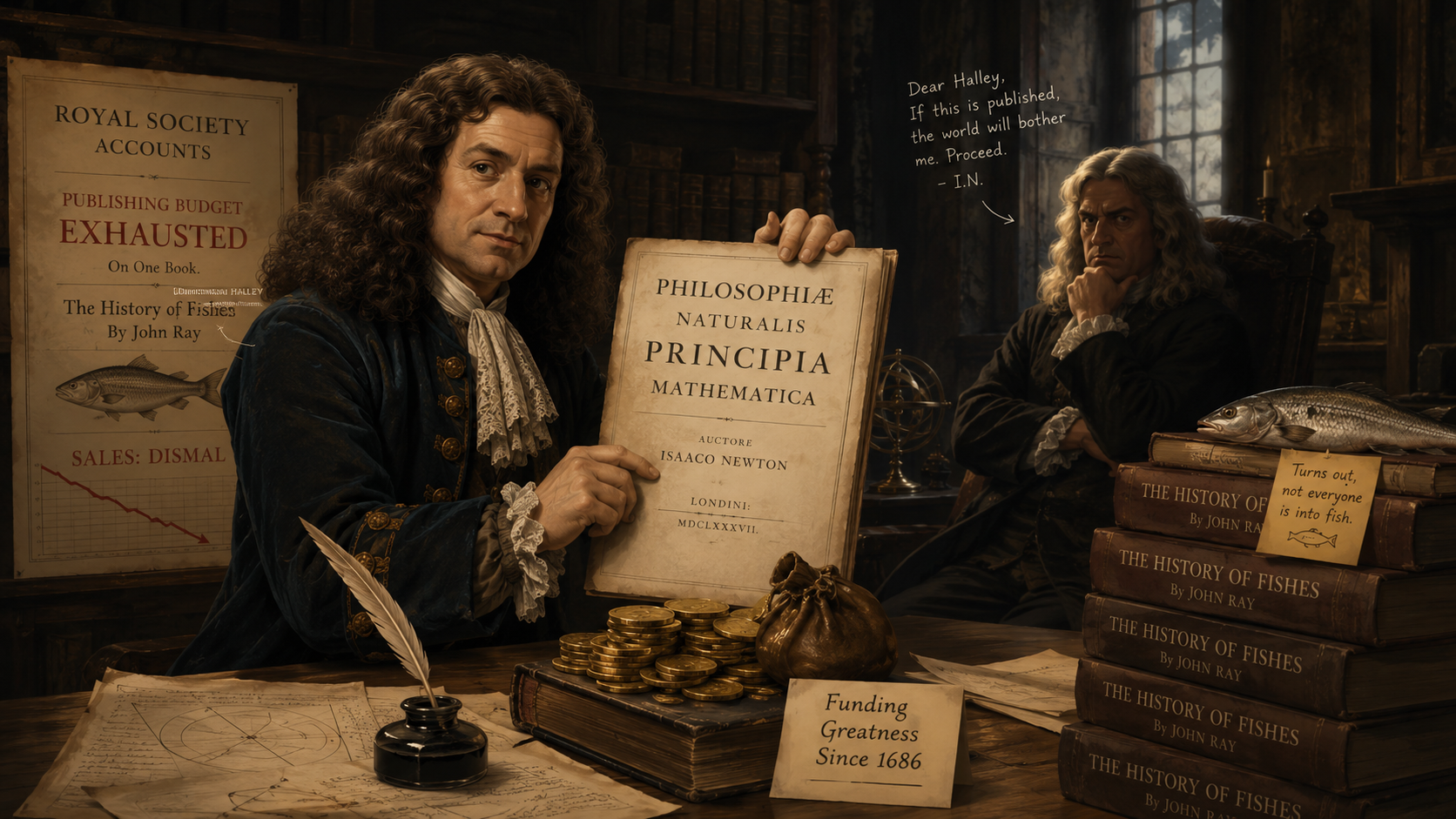
Funding Newton's Principia
1686-06-02Newton wrote the greatest physics book ever, but Halley had to pay for it.
Isaac Newton was brilliant, but he was also incredibly paranoid and hated publishing his work. It took the astronomer Edmond Halley (yes, the comet guy) visiting him and begging him to write down his theories of motion and gravity to finally get the job done.
Newton delivered a manuscript that literally defined classical physics: the Principia. Halley took it to the Royal Society in London to get it published. But there was a massive problem. The Royal Society was completely broke. Why? Because they had just blown their entire publishing budget on a highly-anticipated, massively expensive book called The History of Fishes… which completely flopped. Nobody bought the fish book.
Desperate to get Newton’s genius into the world, Halley literally paid out of his own pocket to have the Principia printed. The Royal Society was so broke they actually paid Halley his clerk salary in leftover copies of the fish book. At least physics survived. 🍎🐟
Publication of Newton’s Principia Mathematica
1687-07-05Isaac Newton drops the ultimate rulebook for the universe.
Before July 1687, the universe was a bit of a chaotic mess—at least in our heads. Then Isaac Newton published Philosophiæ Naturalis Principia Mathematica, and suddenly, everything had to follow the rules. Gravity wasn’t just a suggestion; it was the law.
Newton laid out the three laws of motion and the law of universal gravitation, effectively inventing modern physics while everyone else was still trying to figure out why apples fell down instead of up. It’s arguably the most influential book in the history of science, proving that the same math that governs a falling fruit also keeps the planets in their orbits. Talk about a heavy read. 🍎
Bernoulli's New Year Challenge on the Brachistochrone Problem
1696-01-01Johann Bernoulli's New Year's Day 1696 mathematical challenge ignited a fierce contest among Europe's greatest minds to solve the brachistochrone problem.

Scientific Acceptance of Heliocentrism
1700-01-01Earth wasn't the center of attention? The biggest cosmic glow-up in history!

Invention of Achromatic Lenses
1733-01-01The invention that made telescopes and microscopes actually clear, banishing rainbow-colored blurry vision.

Invention of the Achromatic Lens
1733-01-01The achromatic lens is invented, solving chromatic aberration and bringing sharper, color-true images to telescopes and microscopes.

Definition and Adoption of the Centigrade (Celsius) Temperature Scale
1742-01-01Anders Celsius introduces the 'centigrade' temperature scale, laying the groundwork for the modern Celsius system.

Invention of the Franklin Stove
1742-01-01Benjamin Franklin invents the 'Pennsylvania fireplace' (later known as the Franklin stove), a more efficient and safer heating appliance.

Benjamin Franklin's Electricity Experiments
1752-06-01Benjamin Franklin conducts his legendary kite experiment, proving lightning is electrical and revolutionizing our understanding of electricity.

Franklin's Kite Experiment
1752-06-15Flying a kite in a thunderstorm: historically important, objectively insane.
Ben Franklin is famous for being a founding father, but the man was also a hardcore, utterly fearless science nerd.
In the 1700s, electricity was just a weird parlor trick you did with glass tubes. Franklin had a hunch that the tiny static sparks in his lab were exactly the same thing as the massive lightning bolts in the sky. To prove it, he did something incredibly dangerous. During a massive thunderstorm, he flew a kite made of silk with a metal key tied to the string.
He didn’t actually get struck by a direct bolt (that would have fried him instantly). Instead, the wet string conducted ambient electrical charge from the storm clouds down to the key, where Franklin caught a spark in a Leyden jar. He successfully proved lightning is just giant-scale electricity. He quickly used this knowledge to invent the lightning rod, saving countless homes and churches from burning down. ⚡🪁

First Public Hot Air Balloon Demonstration (Unmanned)
1783-06-04The Montgolfier brothers publicly demonstrated their hot air balloon for the first time, captivating audiences and sparking the race for human flight.

First Manned Hot Air Balloon Flight (Montgolfière)
1783-11-21The Montgolfier brothers' "immense balloon" ushered in the age of flight, lifting humanity's dreams skyward.

First Crewed Hydrogen Balloon Flight by Jacques Charles
1783-12-01Up, up, and away! The hydrogen balloon lifts off, proving humans can indeed fly, thanks to a bit of gas and daring French ingenuity.
Invention of Bifocal Spectacles
1784-01-01No more swapping glasses! Benjamin Franklin's clever solution for two vision problems in one lens, because who has time for two pairs?

Galvani's "Animal Electricity" Discovery
1786-01-01Luigi Galvani's electrifying experiments with frog legs sparked the field of bioelectricity.

The Patenting of the Modern Ball Bearing
1794-01-01From rolling logs to smooth moves: The ball bearing revolutionizes machinery by making friction a thing of the past!

Joseph Bramah Patents the Hydraulic Press
1795-12-19Joseph Bramah's ingenious patent unleashed the mighty power of hydraulics onto the industrial world.

Taking the Leap: The World's First Successful Parachute Jump
1797-10-22Gravity, meet ingenuity! André-Jacques Garnerin's daring leap from a balloon proved the parachute could save lives.

The First Official Metre and Kilogram
1799-06-06The day the French locked the exact length of a metre in a vault.
Before 1799, measuring things was an absolute nightmare. Every single town in Europe had a different definition for a foot or a pound. You could buy a pound of flour in one city and get ripped off in the next town over because their “pound” was completely different.
The French Revolutionaries decided to fix this chaos. They defined a “metre” as exactly one ten-millionth of the distance from the North Pole to the Equator. To make sure nobody could argue about it, they literally cast a definitive bar out of solid platinum, cut to that exact length, and locked it in a secure archive in Paris. They did the same thing with a platinum cylinder for the kilogram.
For nearly two centuries, if you wanted to know exactly how long a metre was, you had to compare it to that specific metal bar in France. It wasn’t until the 1980s that scientists finally ditched the physical bar and redefined the metre using the speed of light. But that platinum bar is the reason your tape measure actually makes sense today. 📏🌍

Invention of the Electric Battery
1800-03-20Alessandro Volta unveils the "Voltaic Pile," the world's first true electric battery, sparking the age of controllable electricity.
John Dalton's Calculation of Relative Atomic Weights
1803-09-01John Dalton cracked the code of atomic weights, giving chemists a way to measure the invisible!
America's First Scientific Eclipse Expedition
1806-06-16In a celestial spectacle, the first U.S. astronomy expedition bravely chased a solar eclipse, proving America's scientific curiosity was truly rising.

Humphry Davy's Bakerian Lecture on Electrochemistry
1806-11-20Humphry Davy unveils how electricity can unravel chemical bonds, laying the groundwork for electrochemistry.
Michael Faraday Becomes Humphry Davy's Assistant
1813-03-01The legendary scientific pairing began when Michael Faraday, a bookbinder's apprentice, joined the illustrious Humphry Davy.
François Arago's Announcement of Electromagnetism
1820-09-11François Arago introduced Ørsted's groundbreaking discovery of electromagnetism to the French scientific community.

Joseph Fourier Introduces the Fourier Series
1822-01-01Joseph Fourier's groundbreaking work revealed how complex waves can be broken down into simple sine and cosine waves.

William Sturgeon Exhibits the First Electromagnet
1825-01-01The Electromagnet: When a simple iron bar got its magnetic mojo from a battery!

Michael Faraday's Public Lectures
1826-01-01Where science met spectacle: Michael Faraday's iconic lectures brought the wonders of physics and chemistry to the masses.
Discovery of Electromagnetic Induction
1831-08-29Michael Faraday finds the trick to turning motion into electricity.
Michael Faraday was a self-taught genius who realized that moving a magnet through a coil of wire creates an electric current.
This simple discovery is the basis for almost every way we generate power today, from wind turbines to nuclear plants. It also gave us the electric motor. When asked what use his discovery was, Faraday reportedly asked, ‘What use is a newborn baby?’ (Yes, scientists use that line a lot). He had just fathered the modern electrical world. ⚡

Faraday's Induction Ring and the First Transformer
1831-08-29Michael Faraday's simple iron ring experiment unveiled the magic of electromagnetic induction, paving the way for modern power.

Faraday Defines Anode and Cathode
1834-01-01The brilliant Michael Faraday coined 'anode' and 'cathode,' giving us the fundamental language to understand electricity!

Michael Faraday Discusses Early Photography
1839-01-01While not an inventor, Michael Faraday contributed to the scientific buzz around early photography, examining its principles.
The Kinetic Theory of Heat
1840-01-01From mysterious fluid to bustling particles: the revolutionary idea that heat is simply motion.

First Official Telegraph Message
1844-05-24Samuel Morse sends the world's first 'text message' via wire.
On May 24, 1844, Samuel Morse sat in the US Capitol and tapped out a series of dots and dashes. Seconds later, his partner in Baltimore received the message: ‘What hath God wrought.’
It was the first long-distance electronic communication in history. Before the telegraph, information traveled at the speed of a horse. Suddenly, it traveled at the speed of light. The world started getting smaller, and the ‘Information Age’ took its first, clicky breaths. 📻

Fizeau and Foucault Capture the Sun's Daguerreotype
1845-04-02Smile for the camera, Sun! The very first photograph of our star was taken, revealing its fiery glory.

Michael Faraday Discovers Diamagnetism
1845-09-01Michael Faraday found that *all* matter is magnetic, some just in the opposite, mind-bending way: diamagnetism!

First Public Demonstration of the Foucault Pendulum
1851-02-03Léon Foucault's captivating pendulum offered visual proof that the Earth really spins.

Riemann Proposes Curved Space
1854-06-10The math lecture that destroyed flat geometry and paved the way for Einstein.
For thousands of years, everyone accepted Euclidean geometry as an absolute law of the universe. A flat plane is flat. Parallel lines never meet. The angles of a triangle add up to 180 degrees. It was rigid and boring.
Then, on June 10, 1854, a painfully shy mathematician named Bernhard Riemann stood up in front of a German university and delivered a lecture that blew geometry wide open.
He proposed that space didn’t have to be flat. What if space was inherently curved? On a curved surface (like a sphere), parallel lines do intersect, and triangles behave completely differently. Even crazier, he built the math to calculate this curvature across higher, invisible dimensions.
People thought it was just a neat, highly abstract puzzle. But 60 years later, Albert Einstein got stuck trying to figure out how gravity works. He dusted off Riemann’s exact equations and realized we literally live in a Riemann space. Gravity is just the curvature of space and time. 🌌📐

Discovery of Caesium and Rubidium
1860-01-01Using spectroscopy, Bunsen and Kirchhoff unveiled two new elements: caesium and rubidium, adding color to the periodic table.
First Practical Internal Combustion Engine
1860-01-01Igniting a Revolution: The Engine That Put the World on Wheels (and More!).

America's First Government-Funded Eclipse Expedition
1869-07-01American scientists embark on their inaugural government-funded journey to chase a total solar eclipse across the continent.

Founding of the Cavendish Laboratory
1874-06-16The world-renowned Cavendish Laboratory is founded at Cambridge, kickstarting an era of groundbreaking physics discoveries.
Signing of the Metre Convention
1875-05-20The world finally agrees on how long a meter actually is.
In 1875, seventeen nations signed a treaty in Paris to establish international standards for the metric system. They created the Bureau International des Poids et Mesures (BIPM).
Before this, a ‘foot’ or a ‘pound’ could vary from city to city, making science and trade a nightmare. The convention established the standard meter and kilogram as physical objects. Today, we’ve replaced those objects with fundamental constants of the universe, but the agreement remains the foundation of all modern science. Measuring twice and cutting once is a lot easier when everyone’s ruler is the same. 📏

Discovery of Gallium
1875-08-01French chemist Paul-Émile Lecoq de Boisbaudran discovered the metallic element Gallium, proving Mendeleev's periodic table prediction.
Development of Practical Electric Arc Lamps
1876-01-01Before Edison's bulb, arc lamps lit up the night with blinding, revolutionary brilliance.

First Successful Voice Transmission over Telephone
1876-03-10'Mr. Watson, come here, I want to see you'—the first words ever transmitted by telephone, changing the world forever.

Edison's Phonograph
1877-08-12The device that let the world record and replay sound, forever changing music, communication, and human memory.

James Dewar's Pioneering Public Lectures at the Royal Institution
1878-01-01Chill out and learn: James Dewar's electrifying lectures brought cutting-edge science to the masses.
Edison's Breakthrough Carbon Filament Experiment
1879-10-21After countless tries, a humble piece of charred cotton thread finally brought practical electric light to the world.

Invention of the Practical Incandescent Light Bulb
1879-10-22The incandescent lamp transformed nights into days, revolutionizing industry and domestic life worldwide.

First public demonstration of a long-lasting incandescent light bulb
1879-12-31Thomas Edison's spectacular New Year's Eve demonstration of his practical incandescent light bulb illuminated the path to modern electric lighting.

First Public Demonstration of the Incandescent Lightbulb
1879-12-31Thomas Edison turns on the night.
On New Year’s Eve in 1879, Thomas Edison filled his Menlo Park lab with a glow that didn’t come from a flame. Hundreds of people took a special train to see the first practical incandescent lightbulb.
Edison didn’t just invent the bulb; he invented the whole system to power it. He showed that electricity could be a safe, clean, and reliable way to banish the darkness. It was a bright idea that literally changed the rhythm of human life, allowing us to stay up way past our natural bedtimes. 💡

US Patent 223,898 Issued for the Electric Lamp
1880-01-27Thomas Edison secures his claim to the lightbulb.
After thousands of failed attempts to find the perfect filament, Thomas Edison finally patented his carbon-filament incandescent lamp.
While he wasn’t the first to dream of electric light, he was the first to make it commercially viable and long-lasting. This patent was the cornerstone of the Edison Electric Light Company, which eventually became General Electric. Edison proved that genius is indeed 1% inspiration and 99% not letting your patent expire. 💡

First Patent for a Functioning Solar Cell
1883-01-01Charles Fritts realizes we can catch the sun in a piece of selenium.
In 1883, Charles Fritts built the first solar array on a New York City rooftop. He used selenium wafers coated with gold.
The efficiency was terrible—only about 1%—but it proved that we could turn light directly into electricity with no moving parts. Fritts predicted that solar would eventually compete with coal. It took 140 years, but he’s finally being proven right. He was the first person to realize that the sun is the ultimate power plant. ☀️

Balmer Series: Unlocking Hydrogen's Spectral Secrets
1885-01-01How a Swiss mathematician made sense of hydrogen's glowing secret.

Capturing a Cosmic Streak: The First Meteor Photograph
1885-11-27Smile for the camera, meteor! Ladislaus Weinek took the first-ever photograph of a meteor, forever changing how we study these cosmic visitors.

Opening of the First Commercial Alternating Current (AC) Power Plant
1886-03-20The "War of the Currents" ignites as the first commercial AC power plant lights up the future, proving alternating current's superiority for transmitting electricity!

Nikola Tesla Patents the AC Induction Motor
1888-05-01Nikola Tesla's 1888 patent for the AC induction motor sparked the Second Industrial Revolution and changed how we power literally everything.

First Photograph of the Aurora
1892-02-15In 1892, astronomer Martin Brendel captured the elusive beauty of the Aurora Borealis on film for the very first time.

First Practical Wireless Telegraphy Demonstration
1895-01-01Guglielmo Marconi famously demonstrated the practical application of radio waves, ushering in the era of wireless communication and connecting the world without wires.

Linde and Hampson Independently Achieve Air Liquefaction
1895-05-01Chilling discoveries in 1895 unlocked the secrets to turning air into a liquid.

Marriage of Marie Sklodowska and Pierre Curie
1895-07-26The union of Marie Sklodowska and Pierre Curie sparked one of science's most revolutionary partnerships.
First Commercial AC Power Plant in the US
1895-08-26The moment alternating current truly sparked into widespread use, powering a city and silencing the 'War of the Currents' debates!

Inauguration of the First Large-Scale Commercial AC Power Plant (Niagara Falls)
1895-08-26George Westinghouse's Niagara Falls power plant sends alternating current to Buffalo, marking a monumental victory in the "War of the Currents."

Discovery of X-rays
1895-11-08Wilhelm Röntgen accidentally sees through his wife's hand.
Wilhelm Röntgen was messing around with vacuum tubes in a dark lab when he noticed a nearby screen glowing. He soon realized that some invisible rays were passing through solid objects—including his own skin.
Naturally, the first thing he did was ask his wife, Anna Bertha, to put her hand in the path of the rays. When she saw the image of her own bones and wedding ring, she reportedly exclaimed, ‘I have seen my death!’ Which, honestly, is a fair reaction to seeing your own skeleton for the first time. Physics: terrifying people since 1895. 🦴

First X-Ray Photograph of a Human Body Part
1895-12-22Röntgen's wife sees her own skeleton and the world is never the same.
Shortly after discovering X-rays, Wilhelm Röntgen took an image of his wife Anna Bertha’s hand. You can clearly see her bones and her wedding ring.
When she saw the image, she famously said, ‘I have seen my death.’ It was a terrifying and thrilling moment. Within months, doctors were using X-rays to find broken bones and bullets. It was the first time we could look inside a living human without a scalpel. It changed medicine overnight. 🦴

First X-ray Photograph Taken in the U.S.
1896-01-02Days after Röntgen's discovery, a groundbreaking X-ray photograph is captured in the U.S., instantly transforming medical diagnostics.

The First X-ray Image Taken in Britain
1896-01-23Less than a month after its discovery, the X-ray pierced through to Britain, revealing bones and revolutionizing medicine!

First Public Exhibition of an X-ray Machine in the U.S.
1896-01-27The invisible becomes visible! America gets its first public peek at the miraculous X-ray machine, revealing bones within living flesh.

Discovery of Radioactivity
1896-03-01Henri Becquerel leaves some uranium in a drawer and finds a new kind of energy.
Henri Becquerel was trying to see if phosphorescent materials emitted X-rays. One day, it was cloudy, so he put his uranium salts and a photographic plate in a dark drawer and waited for the sun to come out.
When he developed the plate, he was shocked to find it was already exposed. The uranium was emitting its own rays, even in the dark! He’d found radioactivity. He shared the discovery with the Curies, who took the research to the next level. Sometimes, a cloudy day is exactly what science needs. ☢️
Edison's Early Contributions and Investigations into X-Rays
1896-03-01Shortly after their discovery, Thomas Edison jumped into the X-ray craze, developing practical applications and facing its hidden dangers.

Discovery of the Electron
1897-04-30J.J. Thomson finds the tiny, negative part of everything.
In 1897, J.J. Thomson announced that atoms weren’t the smallest things in the universe. He discovered ‘corpuscles’ (later called electrons), which were about 1,000 times lighter than a hydrogen atom.
This was a huge deal because it meant atoms actually had internal parts. Thomson’s ‘plum pudding’ model of the atom might not have lasted long, but the discovery of the electron changed everything from chemistry to electronics. Without J.J., you wouldn’t be reading this on a screen right now. Thanks for the subatomic vibes, J.J. ⚡

J.J. Thomson Discovers the Electron
1897-04-30The Electron: J.J. Thomson finds the universe's tiniest electric charge, blowing minds about atoms!

James Dewar's Cryogenic Demonstrations
1898-05-10Watch out, ice cubes! James Dewar revealed the chilling wonders of super-cooled objects, long before 'cool' was even a thing.
Discovery of Polonium and Radium
1898-12-21The Curies find two new elements and a lot of radioactivity in a shed.
Marie and Pierre Curie were the ultimate power couple of science. Working in a leaky shed with tons of pitchblende, they managed to isolate two new elements: Polonium (named after Marie’s native Poland) and Radium.
They didn’t just find new elements; they coined the term ‘radioactivity.’ Radium was so fascinating that people started putting it in everything from watches to toothpaste before realizing that, you know, being glow-in-the-dark might not be great for your health. The Curies sacrificed their own well-being for these discoveries, leaving a glowing legacy—literally. ☢️
American Physical Society (APS) Founded
1899-05-20The American Physical Society (APS) was established, becoming a premier organization for advancing and disseminating physics knowledge.

Development of the Crystal Detector
1901-01-01Tuning into the airwaves: The crystal detector made early radio reception possible.

Development of the Crystal Rectifier
1901-01-01The humble crystal rectifier paved the way for modern electronics by converting AC to DC.

First Nobel Prizes Announced (Physics and Chemistry)
1901-11-12The world's top scientific minds get their moment in the sun as the first Nobel Prizes are decided!
First Transatlantic Radio Transmission
1901-12-12Marconi sends the letter 'S' across the ocean without any wires.
Critics said it was impossible because the Earth is curved and radio waves travel in straight lines. But Guglielmo Marconi didn’t listen. On December 12, 1901, he sat in Newfoundland and heard three faint clicks: the letter ‘S’ in Morse code sent from England.
It turns out the ionosphere reflects radio waves, allowing them to bounce around the curve of the Earth. Marconi had bridged the ocean with nothing but air. Wireless communication was no longer a dream; it was the new reality. 📻

Albert Einstein's first published scientific paper
1902-03-01Before E=mc², Einstein was already making waves, proving even geniuses start small (and with the not-so-glamorous topic of capillarity).

Alpha and Beta Particles Distinguished
1903-01-01Ernest Rutherford gives a name to the distinct types of radiation emitted by radioactive materials: alpha and beta particles.

Edison's Exploration of Radium Emanations for Illumination
1903-01-01Fascinated by new discoveries, Edison briefly explored radium emanations for practical, self-illuminating materials.
Wright Brothers Achieve First Powered Flight
1903-12-17At Kitty Hawk, the Wright brothers defy gravity with the first sustained, powered, controlled flight.

Kristian Birkeland's Electromagnetic Cannon Demonstration
1904-01-01Birkeland's 'electromagnetic cannon' sparked dreams of future super-weapons without gunpowder.

Invention of the Fleming Valve (First Electron Tube)
1904-11-16John Ambrose Fleming's invention of the 'oscillation valve' in 1904 birthed the electron tube, unlocking the era of radio and electronic amplification.

Einstein's 'Annus Mirabilis' Papers Published
1905-01-01A 26-year-old patent clerk has the most productive year in the history of science.
In 1905, Albert Einstein published four papers that fundamentally changed our understanding of the universe. He explained the photoelectric effect (proving light is a particle), Brownian motion (proving atoms exist), Special Relativity (time and space are linked), and E=mc² (energy and mass are the same).
Any one of these would have been a career-defining achievement. Einstein did all four in his spare time while working a 9-to-5 job. It was the most incredible burst of creative genius in history, turning 1905 into the ‘Miracle Year’ of physics. 🧠

Albert Einstein publishes groundbreaking scientific papers (Annus Mirabilis)
1905-03-17In 1905, a patent clerk dropped a series of knowledge bombs that redefined reality, proving you don't need a fancy lab to change the world.

Einstein Publishes on the Quantum Theory of Light
1905-06-09The paper that actually won Albert Einstein his Nobel Prize.
Everyone associates Einstein with relativity, E=mc², and wild hair. But when the Nobel Committee finally gave him a prize in 1921, they specifically ignored relativity because it was still too controversial.
Instead, they gave him the prize for a paper he published in 1905. While working as a literal patent clerk with zero access to a laboratory, Einstein read some work by Max Planck and realized that light doesn’t just flow in a continuous wave. He proposed that light is actually made of distinct, individual little packets of energy, which we now call photons.
He used this to explain the “photoelectric effect”—why shining certain lights on metal makes sparks jump off. Without running a single physical experiment himself, his pure mathematical insight birthed quantum mechanics. He basically reinvented reality on his lunch break. ⚡⚛️

Publication of the Special Theory of Relativity
1905-09-26Albert Einstein makes time and space get weird.
In 1905, a patent clerk named Albert Einstein had a very productive year. His paper on Special Relativity introduced the world to the idea that time isn’t absolute and that the speed of light is the ultimate speed limit.
He also gave us E=mc², the most famous equation in history, proving that mass and energy are just two sides of the same coin. It turns out that if you move fast enough, time actually slows down. So, if you want to live longer, just run really, really fast. (Note: This only works if you run at nearly 300,000 kilometers per second.) 🕒

Lee de Forest's Audion Tube Invention
1906-10-25The Audion tube: a quirky little invention that amplified the world, kickstarting radio and electronics as we know them!

Identification of Alpha Particles as Helium Nuclei
1908-01-01Rutherford uncorks the mystery: Radium's secret message was just baby helium!

Heike Kamerlingh Onnes Successfully Liquefies Helium
1908-07-10A Dutch physicist chilled helium gas colder than anyone thought physically achievable, and opened the door to superconductivity.

Pioneers of Infrared Photography
1910-01-01Seeing beyond the visible: The photographic technique that unveiled hidden worlds.

Discovery of Cosmic Rays
1912-08-07High above Earth, a daring balloon flight revealed mysterious, penetrating radiation showering down from space, forever changing our view of the cosmos.

Discovery of Isotopes
1913-01-01Frederick Soddy coins 'isotope,' revolutionizing our understanding of elements with different atomic masses.
Niels Bohr's Quantum Model of the Atom
1913-07-01In 1913, Niels Bohr dropped a quantum bombshell with his revolutionary model of the atom, giving us a clearer peek into its tiny, buzzing world!

Robert Goddard's First Rocket Patent Granted
1914-07-07Robert Goddard secured his first patent for a multi-stage rocket, setting the conceptual foundation for all future space travel.

Einstein's Theory of General Relativity is published
1915-11-25When Einstein dropped his General Relativity bomb, gravity was no longer just a force, but a warped reality. Mind. Blown.

Einstein's General Relativity proved by solar eclipse observations
1919-05-29A total solar eclipse in 1919 turned a mind-bending theory into undeniable fact, catapulting Einstein into global superstardom overnight.

Discovery of the Proton Announced
1919-08-01Ernest Rutherford knocks the heart out of an atom and finds the proton.
In 1919, Ernest Rutherford showed that when you fire alpha particles at nitrogen gas, you get oxygen and… something else. That ‘something else’ was a hydrogen nucleus, which he realized was a fundamental particle found in all atoms.
He called it the proton (from the Greek for ‘first’). It was the first time someone had deliberately changed one element into another—the dream of the alchemists finally came true, just with more math and fewer potions. Rutherford had found the positive core of our world. ➕
Albert Einstein delivers a significant lecture
1922-12-11When Einstein spoke, the world listened, and sometimes, he even got a Nobel Prize out of it (though not always for the lecture itself!).

Hafnium's Grand Debut: Element 72 Announced
1923-01-02The official announcement of the discovery of hafnium, element 72, confirmed predictions from quantum theory and filled a missing gap in the periodic table.
Robert Goddard's First Liquid-Fueled Rocket Flight
1926-03-16Robert Goddard launched the world's first liquid-fueled rocket, a humble but monumental flight that ignited the age of space exploration.

Development of the Altimeter
1928-01-01That essential gadget telling pilots just how high they're flying (or not).

Discovery of Deuterium (Heavy Hydrogen)
1931-01-01Heavy stuff: Harold Urey discovers deuterium, the universe's 'heavy hydrogen.'
Ernst Ruska and Max Knoll Build the First Electron Microscope
1931-01-01The Electron Microscope: Peering into the tiny universe with beams of electrons, not light!
First Manned Flight into the Stratosphere
1931-05-27Auguste Piccard and Paul Kipfer soar to the edge of space, becoming the first humans to enter the stratosphere!

First Production of Artificial Lightning in a Laboratory
1932-01-01GE engineers unleash a 10-million-volt spark, bringing the fury of a thunderstorm safely indoors.

Invention of the Cyclotron
1932-01-01Ernest Lawrence's cyclotron accelerated particles to unprecedented speeds, opening the door to nuclear physics.

Discovery of the Neutron
1932-02-27James Chadwick finds the neutral glue of the atom.
By 1932, scientists knew about protons and electrons, but the math wasn’t adding up. Atoms were heavier than they should have been. James Chadwick figured out why: there was a third particle in the nucleus that had no charge.
He called it the neutron. This was the missing piece of the puzzle that made nuclear fission possible. It’s the quiet, neutral sibling in the atomic family, but it’s the one that holds everything together—or, if you’re not careful, lets it all blow apart. ⚛️

Discovery of the Positron
1932-08-02Carl Anderson discovers antimatter is actually real.
In 1932, Carl Anderson was looking at cosmic rays and saw something weird: a particle with the mass of an electron but a positive charge. It wasn’t a mistake; it was the positron, the first piece of antimatter ever found.
This confirmed Paul Dirac’s wild mathematical prediction that every particle has an antiparticle. It sounds like science fiction, but it’s why we have PET scans today. Just don’t let a positron shake hands with an electron unless you want a tiny explosion of pure energy. 🎇

Maiden Voyage of the Gyrostabilized Liner, SS Conte di Savoia
1932-11-20The maiden voyage of the *SS Conte di Savoia* marked the debut of the largest passenger liner to feature active gyroscopic stabilization.

Cyclotron Patent Issued to Ernest Lawrence
1934-02-20Ernest Lawrence secures the patent for his groundbreaking particle accelerator, the cyclotron, paving the way for revolutionary atomic research.

Albert Einstein receives the Benjamin Franklin Medal
1935-05-15Einstein added another shiny trinket to his growing collection of accolades, proving that even the smartest people get rewarded for being, well, smart!

Development of Practical Radar Technology
1935-06-17The invisible eyes that transformed warfare and air travel, detecting objects with radio waves!

First Operational Airborne Radar (AI Mk. IV)
1937-01-01From blurry blips to vital vision: The invention of airborne radar utterly transformed aerial warfare and defense!

Development of the Hydrogen Thyratron for Radar Systems
1940-01-01The unsung hero of wartime tech! Hydrogen thyratrons provide the mighty, rapid-fire pulses that made early radar systems truly effective.

Discovery of Astatine
1940-01-01The rarest naturally occurring element on Earth, synthesized and identified in 1940.

Synthesis of Carbon-14
1940-02-27Atomic Age Opens with the Birth of Carbon-14: The isotope that revolutionized dating and medical research.

Development of the Dambuster 'Bouncing Bomb'
1942-01-01The ingenious 'bouncing bomb' designed to skip across water and destroy targets.

First Rocket to Reach Outer Space
1942-10-03Nazi Germany's V-2 rocket, developed under Wernher von Braun, became the first man-made object to reach outer space in 1942.

German V-2 Rocket Program (Peenemünde)
1942-10-03Nazi Germany developed the V-2 rocket, the world's first long-range guided ballistic missile, fundamentally altering modern warfare and space exploration.

US Patent 2,422,460 Issued for the Microwave Oven
1947-06-17Percy Spencer realizes that radar can also melt chocolate and cook dinner.
Percy Spencer was standing near an active radar tube when he noticed the candy bar in his pocket had melted. Instead of just being annoyed, he realized the microwaves were exciting the molecules in the chocolate.
He tested his theory with popcorn (the world’s first microwave snack) and an egg (which exploded). He patented the ‘Radarange,’ which was originally the size of a refrigerator and cost thousands of dollars. Today, it’s the reason we can have a hot meal in 90 seconds. Science: tasty and efficient. 🍿

First Supersonic Flight
1947-10-14Chuck Yeager breaks the sound barrier with two broken ribs and a broom handle.
In the bright orange Bell X-1, nicknamed ‘Glamorous Glennis,’ Chuck Yeager became the first human to fly faster than the speed of sound.
Scientists weren’t sure if the plane would disintegrate when it hit the ‘sound barrier.’ Instead, there was just a loud boom and a smooth ride. Yeager had broken his ribs in a horse-riding accident two days before, so he had to use a sawed-off broom handle to close the hatch. It was the dawn of the supersonic age, where we learned to outrun our own noise. ✈️

First Successful Test of a Working Transistor
1947-12-23Three guys at Bell Labs invent the tiny switch that runs the world.
In December 1947, John Bardeen and Walter Brattain (under William Shockley’s supervision) managed to amplify an electrical signal using a tiny piece of germanium. It was the birth of the transistor.
Before this, computers used vacuum tubes that were bulky, hot, and constantly burning out. The transistor was small, reliable, and efficient. It is the single most important invention of the 20th century. Without it, your phone would be the size of a building and would probably set you on fire. ⚡

Invention of the First Ammonia Maser Atomic Clock
1949-01-01The invention of the atomic clock revolutionized timekeeping, providing unparalleled precision for scientific research and navigation.

US Patent 2,524,035 Issued for the Transistor
1950-10-03The transistor officially gets its paperwork in order.
Three years after the first successful test, Bell Labs was granted the patent for the Point-Contact Transistor.
This document represents the formal beginning of the semiconductor revolution. It marked the end of the vacuum tube era and the start of the digital age. It’s the reason we have computers in our pockets today instead of rooms full of glowing glass tubes. A small patent for a small device that did a very large thing. ⚡

First Dynamic Ultrasound Imaging ('Movie') of the Human Heart
1953-10-29The groundbreaking work of Inge Edler and Hellmuth Hertz brought the human heart to life on screen with the first dynamic ultrasound images, akin to a real-time 'movie.'

A Gem of an Achievement: The First Man-Made Diamonds
1954-12-16Sparkle and science! General Electric's team created the world's first verifiable man-made diamonds, turning a long-held scientific dream into a dazzling reality.
Discovery of the Antiproton
1955-10-21Scientists at Berkeley find the proton's evil twin.
In 1955, Emilio Segrè and Owen Chamberlain used the Bevatron accelerator to create and detect the antiproton. It had the same mass as a proton but a negative charge.
It was the first time an antiparticle for a composite particle had been found, proving that antimatter wasn’t just a quirk of electrons. It confirmed that the universe has a deep, symmetrical nature. It also gave sci-fi writers a lot of cool ideas about antimatter engines, even if we’re still waiting on the warp drive. 🎆

Invention of the Cryotron
1956-01-01The Cryotron: A superconducting switch that promised a chilly future for computing.

Opening of Calder Hall Nuclear Power Station
1956-10-17The world's first commercial-scale nuclear power station plugs into the grid, heralding a new energy era.

Synthesis of Borazon (Cubic Boron Nitride)
1957-01-01The creation of Borazon, a superhard material, provided a synthetic alternative to diamond for industrial applications.
Launch of Explorer 1
1958-01-31America's first satellite finds the invisible belts around our planet.
After Sputnik, the US was under pressure to get into the game. Explorer 1 was their first successful attempt. Unlike Sputnik, it carried scientific instruments.
Led by James Van Allen, the mission discovered the Van Allen radiation belts—bands of charged particles trapped by Earth’s magnetic field. It was the first major scientific discovery of the space age, proving that space wasn’t just empty; it was full of invisible, high-energy drama. 🚀

Launch of Explorer 1, America's First Satellite
1958-02-01Beyond the Atmosphere: America's First Satellite, Explorer 1, Reaches Orbit!

Invention of the Integrated Circuit
1958-09-12The Microchip That Changed Everything: Shrinking Electronics, Expanding Possibilities.

Richard Feynman’s 'There's Plenty of Room at the Bottom' Lecture
1959-12-29Feynman predicts the world of the very, very small.
In a talk at Caltech, physicist Richard Feynman suggested that it should be possible to manipulate and control things on an atomic scale.
He talked about writing the entire Encyclopedia Britannica on the head of a pin and building machines that build even smaller machines. He basically predicted nanotechnology decades before it became a reality. Feynman’s vision showed that the laws of physics didn’t prevent us from working at the atomic level; they just made it interesting. 🔬
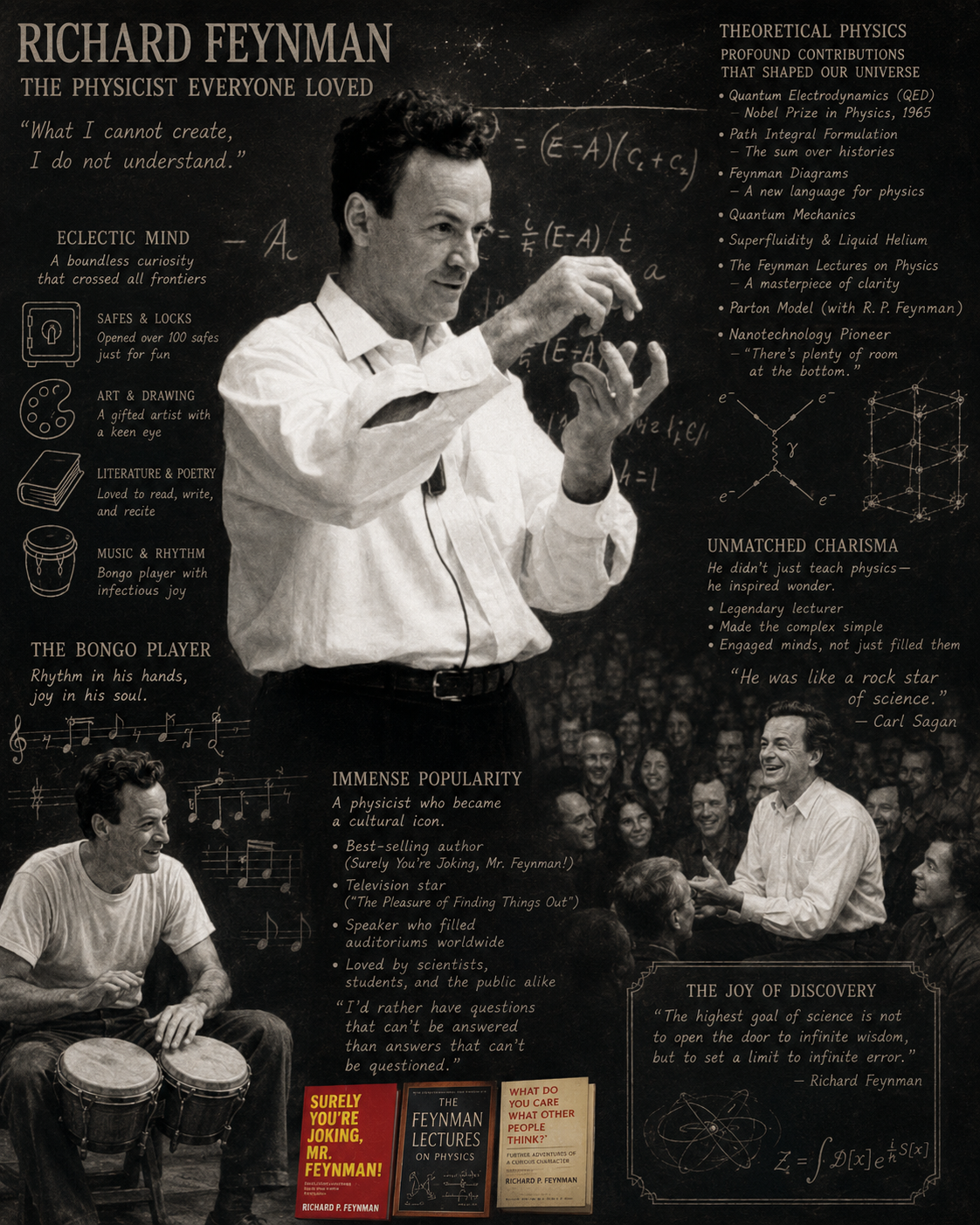
Invention of the Laser
1960-03-22Scientists find a way to make light march in step.
In 1960, a patent was granted for an ‘Optical Maser’—now known as the laser. Charles Townes and Arthur Schawlow figured out how to create a beam of light that is perfectly coherent and focused.
At first, people called the laser ‘a solution looking for a problem.’ Today, we use them for everything: scanning groceries, surgery, cutting steel, and playing DVDs (back when we still did that). It’s a fundamental tool of the modern world, proving that sometimes you just need a very focused light to see the way forward. 🔦

Invention of Satellite Navigation (Transit System)
1960-04-13The Space Race gave us more than moon shots; it birthed satellite navigation, revolutionizing how we find our way around.

Operation of the First Ruby Crystal Laser
1960-05-16Theodore Maiman, working at Hughes Research Laboratories, demonstrated the world's first operational laser using a synthetic ruby crystal in 1960.

First Flight of a Liquid Hydrogen-Fueled Rocket Stage (Centaur)
1962-05-08Clean burn, big thrust! Liquid hydrogen fuels the future of space travel, propelling rockets like Centaur and Saturn V towards the stars.
First Discovery of a Quasar
1963-02-05Maarten Schmidt finds a star that's actually a galaxy-sized engine from the edge of time.
Maarten Schmidt was looking at a ‘star’ called 3C 273 when he realized its light was incredibly red-shifted. It wasn’t a star at all; it was an object billions of light-years away.
He had found a quasar—the incredibly bright core of a distant galaxy powered by a supermassive black hole. Quasars are the most luminous objects in the universe, shining brighter than hundreds of galaxies combined. They are the roaring engines of the early universe, and finding them changed our understanding of cosmic history. 🌌

NASA Project Gemini III Mission
1965-03-23Molly Brown Takes Flight: Gemini III Blasts Off, Marking NASA's First Two-Person Space Mission!

First American Spacewalk (Gemini IV EVA)
1965-06-03Ed White stepped out, floated free, and made America's first spacewalk look effortlessly cool!

Japan's First Satellite Launch (Ōsumi)
1970-02-11Japan rockets into the space age, launching its very first satellite, Ōsumi!

Inauguration of the Odeillo Solar Furnace (First Major French Solar Research Facility)
1970-11-01France harnesses the sun's fury with the Odeillo Solar Furnace, pioneering concentrated solar power for high-temperature research!

Alan Shepard's Lunar Golf Shot
1971-02-06Astronaut Alan Shepard made history and headlines by hitting two golf balls on the Moon during the Apollo 14 mission!

Establishment of Coordinated Universal Time (UTC)
1972-01-01The global standard for timekeeping, ensuring consistent measurement of time across the world for everything from space travel to internet communication.

First CAT scan patent granted
1972-01-01The patent that launched a revolution in medical diagnostics, letting doctors peek inside like never before.

India's First Satellite: Aryabhata
1975-04-19The launch of Aryabhata marked India's entry into the space age, a monumental stride in scientific and technological self-reliance.

First Magnetic Resonance Imaging (MRI) Scan
1977-07-03Raymond Damadian takes the first high-definition look inside a human body.
The first human MRI scan took five hours to produce a single image. Raymond Damadian and his team built the massive machine, nicknamed ‘Indomitable,’ themselves.
MRI uses powerful magnets and radio waves to make the protons in your body’s water molecules dance, creating incredibly detailed images of soft tissues without using radiation. Today, we can get a full-body scan in minutes. It is the ultimate tool for non-invasive diagnosis, allowing doctors to see everything from tumors to torn ligaments with crystal clarity. 🧲

Chernobyl Nuclear Power Plant Explosion
1986-04-26Humanity's worst nuclear nightmare unfolds as Reactor No. 4 at Chernobyl erupts in a devastating explosion.

The Cold Fusion Announcement (Fleischmann-Pons Experiment)
1989-03-23Scientists Martin Fleischmann and Stanley Pons shocked the world with claims of tabletop nuclear fusion at room temperature.
Philips Introduces the E-Lamp (Electroluminescent Lamp)
1992-01-01Philips develops the E-Lamp, an energy-efficient, long-lasting electrodeless fluorescent lamp, offering a new alternative to traditional light bulbs.

Global Positioning System (GPS) Becomes Fully Operational
1995-04-26From military secret to everyday navigation, GPS went fully online, changing how we find our way (and our lost keys).

Creation of the First Bose-Einstein Condensate
1995-06-05Scientists cool atoms so much they stop acting like individuals and start acting like one giant 'super-atom'.
Predicted by Einstein and Satyendra Nath Bose in the 1920s, the Bose-Einstein Condensate (BEC) was finally created in 1995.
By cooling rubidium atoms to just a fraction of a degree above absolute zero, Eric Cornell and Carl Wieman forced them into the same quantum state. It’s a new state of matter where quantum effects become visible to the naked eye. It’s the ultimate chill-out session for atoms, proving that things get very weird when you turn the temperature down. ❄️

Discovery of the First Exoplanet Around a Sun-like Star
1995-10-06Astronomers find 51 Pegasi b and prove that other suns have other worlds.
For centuries, we wondered if our solar system was unique. In 1995, Michel Mayor and Didier Queloz found the answer: no. They discovered 51 Pegasi b, a giant planet orbiting a star 50 light-years away.
It was a ‘Hot Jupiter’—a massive gas giant orbiting so close to its sun that its ‘year’ is only four days long. This discovery blew up our theories of how planets form and kicked off the hunt for thousands of other worlds. We now know that there are more planets in the galaxy than there are stars. Space just got a lot more crowded. 🪐

Isolation of Graphene Announced
2004-10-22Two scientists use a piece of Scotch tape to find the strongest material in the world.
In 2004, Andre Geim and Konstantin Novoselov managed to isolate a single layer of carbon atoms—graphene. How? They used a piece of adhesive tape to peel layers off a block of graphite until they had a sheet just one atom thick.
Graphene is 200 times stronger than steel, a better conductor than copper, and almost transparent. It’s a 2D material with 3D possibilities. The duo won the Nobel Prize for their ‘Friday Night Experiments,’ proving that you don’t always need a billion-dollar lab to change the world; sometimes, you just need some tape. 💎

Announcement of the Discovery of the Higgs Boson
2012-07-04CERN finds the 'God Particle' that gives everything mass.
On July 4, 2012, physicists at the Large Hadron Collider announced they’d found a particle that looked a lot like the Higgs Boson.
This particle is the manifestation of the Higgs field, which is what gives other particles their mass. Without it, the universe would just be a bunch of weightless particles flying around at the speed of light. Finding it was the final piece of the Standard Model of particle physics. Peter Higgs, who predicted it in 1964, was in the audience and was seen wiping away a tear. Not bad for a day’s work. 🎆

Felix Baumgartner's Supersonic Stratos Jump
2012-10-14The daring leap from the edge of space that shattered records and pushed human limits.

First Direct Detection of Gravitational Waves by LIGO
2015-09-14The Universe's first whisper: LIGO catches cosmic ripples, proving Einstein right (again!).

First Direct Image of a Black Hole Released
2019-04-10The world gets its first look at the un-lookable.
Black holes are famous for not letting light escape, which makes them notoriously difficult to photograph. But the Event Horizon Telescope team didn’t let that stop them. By syncing up radio telescopes across the globe, they created an Earth-sized lens.
The result was a fuzzy, orange ‘donut’ of light surrounding the supermassive black hole at the center of galaxy M87. It confirmed that Einstein was right (again) and gave humanity a glimpse into the most extreme environment in the cosmos. It’s the ultimate profile picture for the universe. 🍩

First Room-Temperature Superconductor Claim
2020-10-14Scientists claim to find the holy grail of materials science (with a lot of pressure).
In 2020, researchers claimed to have found a material that could conduct electricity without any resistance at room temperature.
There was a catch: it required the pressure of 2.6 million atmospheres (about the same as at the center of the Earth). While the original paper was later retracted and the field remains highly controversial, the event sparked a massive surge of interest in finding a practical room-temperature superconductor. If we ever find one that works at normal pressure, it would revolutionize everything from the power grid to levitating trains. 🧲

Einstein's handwritten E=mc² letter sold at auction
2021-05-21A tiny letter with the universe's most famous equation fetched a fortune, proving that sometimes, even genius needs a good pen (and a hefty bank account).

The Space Race
Journey back to the era when we unlocked the power of the nucleus and changed the world forever.
First Public Hot Air Balloon Demonstration (Unmanned)
1783-06-04The Montgolfier brothers publicly demonstrated their hot air balloon for the first time, captivating audiences and sparking the race for human flight.
First Crewed Hydrogen Balloon Flight by Jacques Charles
1783-12-01Up, up, and away! The hydrogen balloon lifts off, proving humans can indeed fly, thanks to a bit of gas and daring French ingenuity.
First free-flying balloon for meteorological observations
1783-12-01Early balloon flights didn't just thrill crowds; they launched meteorology into the skies, providing the first direct peek into the atmosphere's secrets.

Jean-Pierre Blanchard's First Solo Hot Air Balloon Flight
1784-03-02Jean-Pierre Blanchard soared into history in 1784 with his groundbreaking solo hot air balloon ascent, pioneering human flight!

First Manned Balloon Ascent in Britain
1784-09-15Vincenzo Lunardi soared into British history with the nation's inaugural manned balloon flight.

First Aerial Crossing of the English Channel by Balloon
1785-01-07Two daring aeronauts brave icy winds to conquer the English Channel by balloon!

Development and Application of Aerial Photography
1858-01-01The evolution of capturing Earth from above, transforming everything from warfare to urban planning.

First Successful Aerial Photograph Taken from a Balloon
1860-10-13Gazing down on Boston, the first "bird's eye view" photo forever changed perspectives.

First Telegraphic Communication from a Balloon
1861-10-01Taking 'reaching out' to new heights: Telegraphy from a balloon debuts during the American Civil War!

First Official Balloon Air Mail Service During the Siege of Paris
1870-09-23When regular mail just won't cut it: Paris besieged turns to hot air for desperate deliveries!

Andrée's Arctic Balloon Expedition
1897-07-11A daring, ill-fated Swedish attempt to reach the North Pole by hydrogen balloon, ending in tragedy and mystery.

First Sustained, Powered Airplane Flight
1903-12-17Two bicycle mechanics from Ohio finally get off the ground.
At Kitty Hawk, North Carolina, Orville Wright took off in a wooden flyer and stayed in the air for a whopping 12 seconds. It wasn’t a long trip—only about 120 feet—but it was the first time a human had achieved controlled, powered flight.
The Wright brothers’ success came from their obsession with control and their experience building bikes. By the end of the day, Wilbur had flown for 59 seconds. The sky was no longer the limit; it was the new highway. ✈️

First Aerial Photograph of Stonehenge
1906-01-01Stonehenge got its first bird's-eye view, courtesy of a balloon and a camera, revealing ancient secrets from above.

US Patent 821,393 Issued for the Flying Machine
1906-05-22The Wright brothers patent the art of staying up.
Nearly three years after their first flight, the Wright brothers finally received a patent for their ‘Flying Machine.’
Crucially, the patent wasn’t just for the plane itself, but for the system of ‘wing-warping’ that allowed them to control it. They spent much of the next decade in court defending this patent against other pioneers like Glenn Curtiss. It shows that even in the sky, you can’t escape the lawyers. ✈️

First International Balloon Race (Gordon Bennett Cup)
1906-09-30The inaugural Gordon Bennett Cup launched an epic international balloon race, pitting daredevil aeronauts against each other in a thrilling test of skill and endurance.

First Documented Vertical Flight by a Manned Helicopter
1907-11-13French inventor Paul Cornu achieved the world's first documented vertical flight in his experimental helicopter, lifting off the ground just a few years after the Wright brothers' first flight.

Establishment of the French Military Air Service (Aéronautique Militaire)
1909-03-22France takes to the skies, establishing its pioneering military air service and forever changing the face of warfare!

Louis Blériot Receives First Pilot's License
1910-01-07License to fly! Aviation pioneer Louis Blériot became the proud owner of the world's very first official pilot's license.

Glenn Curtiss Conducts Early Airplane Bomb-Drop Tests
1910-08-01Before bombing became warfare, Glenn Curtiss tested how to drop explosives from the sky.

Grant Morton's Daring Aerial Leap
1911-06-18Hold onto your hats! The very first human took a literal leap of faith from an airplane with a parachute.

First four-engine plane takes flight
1913-05-10Igor Sikorsky's Russky Vityaz pioneered multi-engine flight, revolutionizing aviation with unprecedented power and capacity.

First Successful Airplane Launch from an Airship
1918-07-21Aerial motherships emerge as planes launched from airships in a daring WWI experiment.

First Non-Stop Flight from England to Australia
1919-12-10The Smith brothers and their crew made history with the first flight from England to Australia, a grueling 18,000-kilometer aerial marathon.

First Commercial Cropdusting Flight
1921-08-03The cropduster revolutionized agriculture by enabling widespread aerial application of pesticides and fertilizers, covering huge fields in a fraction of the time.

Christening of the USS Shenandoah (ZR-1)
1923-10-20America takes to the skies with its first mighty rigid airship!

First Non-Stop Solo Transatlantic Flight
1927-05-20Charles Lindbergh flies from New York to Paris with nothing but sandwiches and determination.
In the ‘Spirit of St. Louis,’ Charles Lindbergh spent 33.5 hours alone in a cramped cockpit, fighting sleep and fog as he crossed the Atlantic.
When he landed in Paris, 150,000 people were waiting for him. He became an instant global superstar. His flight proved that long-distance air travel was possible and paved the way for the commercial aviation industry. He showed that the ocean was no longer a barrier, but just a long afternoon’s flight. ✈️

Development of the Altimeter
1928-01-01That essential gadget telling pilots just how high they're flying (or not).
First Westward Non-Stop Transatlantic Flight (The "Bremen")
1928-04-12Against fierce headwinds, a German-Irish crew in the Junkers W33 "Bremen" accomplished the first non-stop westward transatlantic flight, a notoriously challenging aviation feat.

First Manned Flight into the Stratosphere
1931-05-27Auguste Piccard and Paul Kipfer soar to the edge of space, becoming the first humans to enter the stratosphere!
First Successful Flight of a Practical Helicopter
1936-06-26Germany builds a flying machine that can actually stay in one place.
The Focke-Wulf Fw 61 was the first fully controllable helicopter. It could take off vertically, hover, and fly forward, backward, and sideways.
Before this, ‘autogyros’ had been around, but they couldn’t hover. The Fw 61 proved that vertical flight was a practical reality. It opened up a new world of aviation where you didn’t need a runway—just a flat spot of ground. It was the birth of the most versatile vehicle in the sky. 🚁

First jet aircraft launch from an aircraft carrier
1945-11-06Commander Eric Brown made history by executing the first jet take-off from an aircraft carrier, propelling naval aviation into the supersonic age.

First Still Photograph of Earth from Space
1946-10-24The very first selfie our planet ever took, thanks to a captured V-2 rocket and a plucky camera.

Chuck Yeager Breaks the Sound Barrier in the Bell X-1
1947-10-14Boom! Chuck Yeager smashes the sound barrier in a rocket-powered flight!

First Supersonic Flight
1947-10-14Chuck Yeager breaks the sound barrier with two broken ribs and a broom handle.
In the bright orange Bell X-1, nicknamed ‘Glamorous Glennis,’ Chuck Yeager became the first human to fly faster than the speed of sound.
Scientists weren’t sure if the plane would disintegrate when it hit the ‘sound barrier.’ Instead, there was just a loud boom and a smooth ride. Yeager had broken his ribs in a horse-riding accident two days before, so he had to use a sawed-off broom handle to close the hatch. It was the dawn of the supersonic age, where we learned to outrun our own noise. ✈️
First Commercial Jet Airliner Flight
1952-05-02The de Havilland Comet takes to the skies, making air travel fast and quiet.
In 1952, the British-built de Havilland Comet flew from London to Johannesburg, ushering in the Jet Age. Jet engines were faster, smoother, and quieter than the old propeller engines.
While the Comet eventually suffered from tragic structural failures (due to the then-unknown problem of metal fatigue), it set the standard for modern air travel. It showed that we could cross continents in hours instead of days. The world was shrinking, and the vacation was never the same again. ✈️

First Air-Delivered Hydrogen Bomb Test (Operation Redwing - Cherokee)
1956-05-21The chilling aerial debut of the hydrogen bomb, showcasing ultimate destructive power.

Launch of Sputnik 1
1957-10-04A beeping metal ball from the USSR starts the Space Race.
On October 4, 1957, the Soviet Union launched Sputnik 1, the first artificial satellite, into orbit. It was about the size of a beach ball and did nothing but emit a steady ‘beep-beep-beep’ on radio frequencies.
That simple beep terrified the West and kicked off the Space Race. It proved that humanity could actually leave the planet and put something into orbit. It was a wake-up call for science education and technological development that would eventually lead us to the Moon. 🛰️

Launch of Explorer 1
1958-01-31America's first satellite finds the invisible belts around our planet.
After Sputnik, the US was under pressure to get into the game. Explorer 1 was their first successful attempt. Unlike Sputnik, it carried scientific instruments.
Led by James Van Allen, the mission discovered the Van Allen radiation belts—bands of charged particles trapped by Earth’s magnetic field. It was the first major scientific discovery of the space age, proving that space wasn’t just empty; it was full of invisible, high-energy drama. 🚀
Launch of Explorer 1, America's First Satellite
1958-02-01Beyond the Atmosphere: America's First Satellite, Explorer 1, Reaches Orbit!
First Human Voice Broadcast from Space
1958-12-19President Eisenhower's Christmas message from orbit marked the first human voice broadcast from space, ushering in a new era of satellite communication.

Kremer Prize for human-powered flight established
1959-11-20The Kremer Prize dared engineers to conquer the skies with only muscle power, sparking a multi-decade quest for human-powered flight.

First Television Pictures of Earth from Space (TIROS-1)
1960-04-01When Earth made its TV debut, captured from orbit by a pioneering weather satellite.

First Animals to Return Safely from Orbit (Sputnik 5)
1960-08-19Soviet dogs Belka and Strelka became canine cosmonauts, the first animals to orbit Earth and return safely, paving the way for human spaceflight.

First Human in Space
1961-04-12Yuri Gagarin takes a 108-minute trip that changes everything.
In 1961, Yuri Gagarin squeezed into the tiny Vostok 1 capsule and became the first human to orbit the Earth. As he blasted off, he famously shouted ‘Poyekhali!’ (Let’s go!).
Gagarin’s flight lasted less than two hours, but it shattered the psychological barrier of what humans could achieve. He returned a global hero, proving that a person could survive the vacuum of space and the heat of reentry. The door to the stars was officially open. 👨🚀

Clear Photographic Evidence of Earth's Curvature from Orbit
1962-02-20When John Glenn showed the world, from orbit, that Earth truly is round (and didn't look flat after all).

JFK’s 'We choose to go to the Moon' Speech
1962-09-12JFK explains that we're going to the Moon because it's hard, not because it's easy.
Standing in a football stadium at Rice University, President Kennedy committed the US to landing a man on the Moon by the end of the decade.
He acknowledged the massive technological challenges but argued that the quest for knowledge and the spirit of exploration were worth the effort. His speech galvanized the nation and secured the funding for the Apollo program. It’s one of the most inspiring calls to scientific action ever delivered. ‘The greater our knowledge increases, the greater our ignorance unfolds.’ 🌕

Launch of NASA's Explorer 16 Satellite
1962-12-16Zipping into space, Explorer 16 was NASA's plucky little scout sent to brave the cosmic shooting gallery and study micrometeoroids!

First Woman in Space (Valentina Tereshkova)
1963-06-16Valentina Tereshkova proves that the stars don't have a 'no girls allowed' sign.
In 1963, Valentina Tereshkova blasted off in Vostok 6, becoming the first woman to orbit the Earth. She spent three days in space, orbiting 48 times—more than all the American astronauts combined at that point.
A former factory worker and amateur skydiver, she proved that women had the ‘right stuff’ just as much as men. It would be another 20 years before the US sent Sally Ride into space, but Tereshkova had already shattered the ultimate glass ceiling. 👩🚀
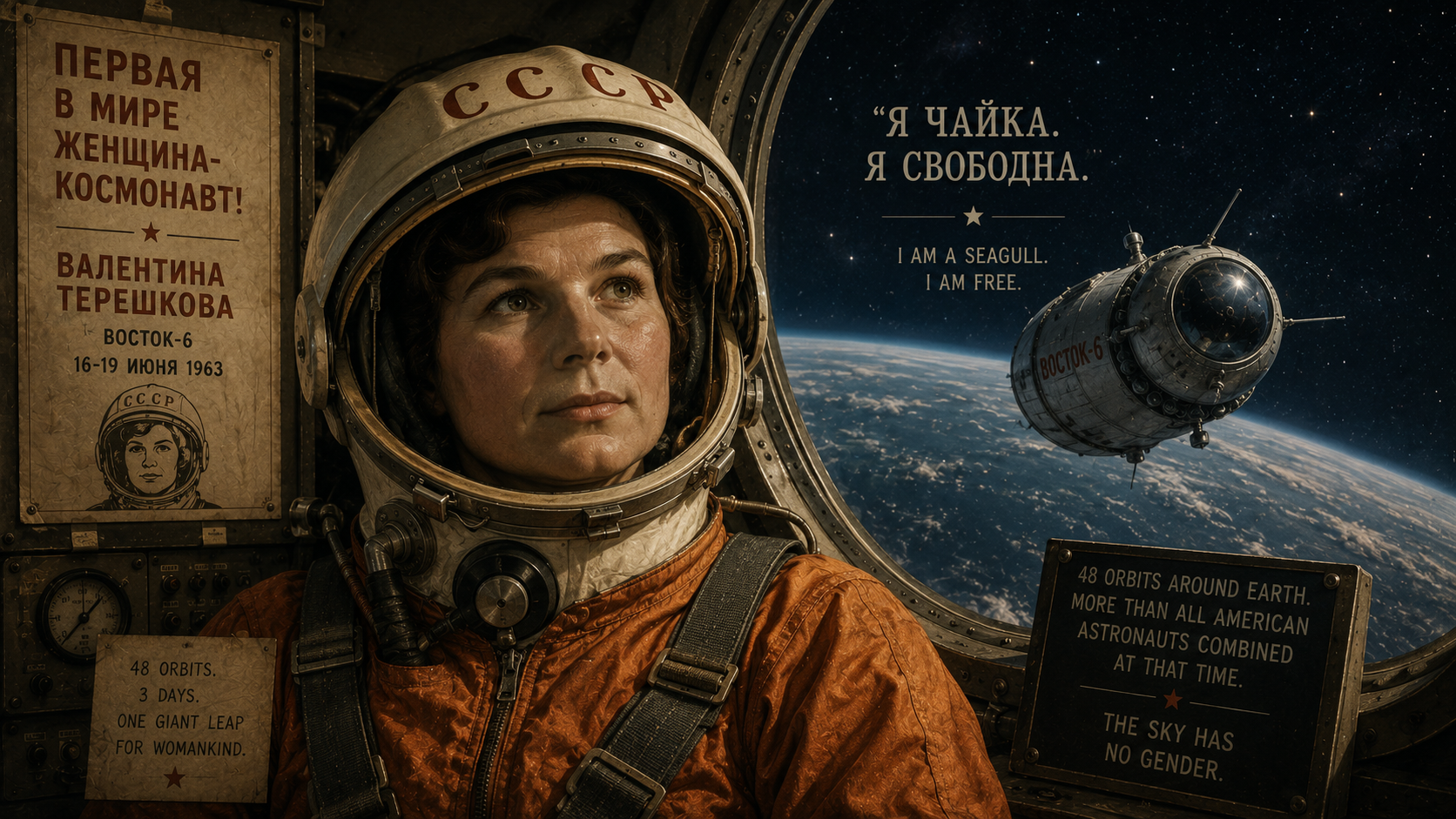
First Spacewalk
1965-03-18Alexei Leonov takes a 12-minute stroll in the ultimate void.
Alexei Leonov became the first person to leave his spacecraft and float in open space. He was tethered by a 17-foot cable and spent 12 minutes outside Voskhod 2.
It wasn’t all smooth sailing; his spacesuit puffed up in the vacuum so much that he couldn’t get back through the airlock. He had to manually bleed some oxygen out of his suit to shrink enough to fit back inside. Talk about a high-stress exit strategy. He proved that humans could work outside their ships, a necessity for everything from repairs to Moon landings. 👨🚀

First Soft Landing on the Moon
1966-02-03The Soviet Union's Luna 9 probe achieved the first soft landing on the Moon, sending back the inaugural panoramic images from the lunar surface.

First High-Altitude Balloon Observation of a Total Solar Eclipse
1966-11-12NASA sends astronomers sky-high for a dazzling, unobstructed view of a solar eclipse!

Signing of the Outer Space Treaty
1967-01-27The world agrees that space belongs to everyone and no one can put a nuke there.
As the Space Race heated up, the US and USSR realized they needed some ground rules for the final frontier. The Outer Space Treaty established that space is ’the province of all mankind.'
It banned nuclear weapons in orbit, forbade countries from claiming land on the Moon or other planets, and made countries responsible for the damage their spacecraft cause. It’s the ‘Magna Carta of Space,’ ensuring that even if we fight on Earth, we keep the peace among the stars. 🌌

First African-American Selected for a U.S. Space Program
1967-06-26Breaking barriers beyond Earth's atmosphere: The first African-American selected for a space mission!

Launch of Explorer 38 (Radio Astronomy Explorer-1, RAE-1)
1968-07-04Happy Independence Day! Explorer 38 launched to listen to the universe's radio whispers, far away from Earth's noisy static.

Apollo 8 Becomes the First Crewed Spacecraft to Orbit the Moon
1968-12-24Three humans spend Christmas Eve looking at the Earth from the Moon.
In 1968, Apollo 8 took Frank Borman, Jim Lovell, and Bill Anders to the Moon. They didn’t land, but they were the first humans to see the ‘far side’ with their own eyes.
On Christmas Eve, they broadcasted a message back to Earth while orbiting the lunar surface. But the most enduring legacy was the ‘Earthrise’ photograph—a tiny, blue marble hanging in the blackness of space. It changed how we saw our home, making it look fragile, beautiful, and lonely all at once. 🌍

First Photograph of Earth from the Moon ('Earthrise')
1968-12-24Bill Anders captures the most influential environmental photo ever taken.
While orbiting the Moon on Apollo 8, Bill Anders saw something that wasn’t in the mission plan: the Earth rising over the lunar horizon. He scrambled for his camera and captured a color photo of our home.
‘We came all this way to explore the moon, and the most important thing is that we discovered the Earth,’ he said. The photo showed a small, blue, fragile oasis in the infinite dark. It helped spark the modern environmental movement, reminding us that we’re all on the same small boat together. 🌍

Concorde's First Flight
1969-03-02The Anglo-French supersonic marvel took to the skies, shrinking the world for luxury travelers.

Apollo 11 Moon Landing
1969-07-20Neil Armstrong takes one small step and a giant leap for all of us.
On July 20, 1969, the Eagle landed at Tranquility Base. Neil Armstrong and Buzz Aldrin became the first humans to set foot on another world, while Michael Collins kept the ‘getaway car’ running in orbit.
Armstrong’s ‘one small step’ was watched by an estimated 650 million people. It remains the pinnacle of human exploration and technological achievement. We proved that we could leave our cradle and touch the heavens. And yes, they brought back rocks. Lots of very expensive rocks. 🌕

Concorde Reaches Mach 1
1969-10-01Concorde breaks the sound barrier, proving that commercial supersonic travel was no longer a pipe dream.

First Space Station Launched (Salyut 1)
1971-04-19The Soviet Union builds the first studio apartment in orbit.
In 1971, the USSR launched Salyut 1, the world’s first space station. It wasn’t just a capsule; it was a laboratory where cosmonauts could live and work for weeks at a time.
It paved the way for Skylab, Mir, and eventually the International Space Station. Salyut 1 showed that space could be more than just a destination for a quick visit; it could be a place where humans actually reside. Living in a metal tube in a vacuum: the ultimate test of roommate compatibility. 🛰️

Launch of the First Space Station
1971-04-19The Soviet Union launched Salyut 1, the world's first space station, initiating an era of long-duration human presence in Earth orbit.

Britain launches its first home-grown satellite, Prospero
1971-10-28Up, up, and away! Britain's first satellite, Prospero, makes history by rocketing into orbit.

Launch of Pioneer 10
1972-03-03Pioneer 10 is the first spacecraft to survive the asteroid belt and head for the exit.
Pioneer 10 was the first true deep-space explorer. It was the first spacecraft to travel through the asteroid belt (proving it wasn’t a wall of death) and the first to get a close look at Jupiter.
On board is a famous plaque designed by Carl Sagan, showing humans and our location in the galaxy, just in case any extraterrestrials find it. It’s currently billions of miles away, heading toward the star Aldebaran. It’ll get there in about 2 million years. Hope they like our drawings. 🛰️

Launch of the Voyager 2 Probe
1977-08-20Voyager 2 begins its epic grand tour of the outer planets.
Voyager 2 was launched slightly before its twin, Voyager 1, but followed a different path. It is the only spacecraft to have visited all four ‘gas giants’: Jupiter, Saturn, Uranus, and Neptune.
It gave us our first close-ups of the blue clouds of Neptune and the tilted rings of Uranus. Like its twin, it carries a Golden Record. Voyager 2 is a marathon runner of science, still sending back data from the very edge of our sun’s influence. It’s the ultimate overachiever. 🛰️

Voyager 1 Probe Launched
1977-09-05Humanity's farthest-traveling messenger begins its endless journey.
Voyager 1 was launched to explore the outer planets, but it just kept going. It gave us our first close-ups of Jupiter and Saturn, showing us volcanic moons and intricate rings.
On board is a Golden Record containing sounds and images of Earth, just in case any aliens want to know what we’re about. In 2012, it became the first human-made object to enter interstellar space. It’s still out there, billions of miles away, whispering back to us from the dark. 🛰️

Launch of the International Cometary Explorer (ICE)
1978-08-12From Solar Wind Hunter to Comet Interceptor: ICE's Epic Cosmic Repurpose.

Double Eagle II Completes the First Successful Transatlantic Balloon Crossing
1978-08-17After more than a century of failed and fatal attempts, three Americans finally floated a balloon all the way across the Atlantic.

First Manned Flight of a Solar-Powered Airplane
1980-05-18The Gossamer Penguin flies on nothing but sunshine.
Designed by the legendary Paul MacCready, the Gossamer Penguin was a lightweight aircraft powered entirely by solar cells. On its first flight, it carried MacCready’s 13-year-old son, Marshall.
It wasn’t a fast plane, but it proved that renewable energy could be used for flight. It paved the way for the Solar Impulse, which eventually flew around the world. It showed that the future of aviation doesn’t have to be loud or dirty; it can be as quiet as a sunbeam. ☀️

First Unpowered Flight Across English Channel by Balloon
1980-07-19Aeronaut Julian Nott famously glided across the English Channel in a hot air balloon, making history without a single engine rev.

First Flight of the Space Shuttle (Columbia)
1981-04-12The world's first reusable spacecraft takes its maiden voyage.
On the 20th anniversary of Gagarin’s flight, NASA launched Columbia. Unlike previous spacecraft that were one-and-done, the Shuttle was designed to fly, land like a plane, and fly again.
It was a technological marvel and the workhorse of the US space program for 30 years. It launched satellites, repaired Hubble, and built the ISS. The Shuttle made space feel almost routine—at least until we were reminded of how dangerous it really is. It was a bold attempt to make space travel sustainable. 🚀

First Non-Stop Flight Around the World Without Refueling
1986-12-23Two pilots spend nine days in a flying gas tank to circle the globe.
The Rutan Voyager was a bizarre-looking plane made of carbon fiber and filled with fuel. Dick Rutan and Jeana Yeager spent nine days, three minutes, and 44 seconds in a cockpit the size of a phone booth.
They flew 26,000 miles without once touching the ground or taking on more fuel. It was an incredible feat of endurance and efficiency, proving that with the right materials and design, you can go anywhere on Earth in one go. It’s the ultimate road trip, without the roads. ✈️

Israel's First Satellite Launch: Ofeq-1
1988-09-19Israel joins the exclusive club of space-faring nations with the launch of its first satellite, Ofeq-1.

Launch of the Hubble Space Telescope's First Public Image
1990-05-20The world gets its first look from Hubble, and it's... a little blurry.
Hubble’s ‘First Light’ image was of a star cluster called NGC 3532. It was better than ground-based photos, but it revealed a problem: the telescope’s mirror was slightly the wrong shape.
This led to a PR disaster and eventually a heroic repair mission in 1993. But even with blurry vision, Hubble showed that we had a powerful new eye in the sky. It was the shaky first step toward the most incredible gallery of cosmic images ever produced. 🔭

Biosphere 2's Initial Mission Begins
1991-09-26A daring attempt to build a self-sustaining miniature Earth under glass in the Arizona desert!

COBE satellite deorbited
1996-01-12After revolutionizing our understanding of the early universe, the COBE satellite made its final fiery descent.

Launch of the First International Space Station Module
1998-11-20Orbiting Laboratory Takes Flight: The International Space Station Begins its Grand Assembly.

Concorde Fleet Retirement
2003-10-24The iconic supersonic jets made their final landings, marking the end of an extraordinary era of luxury air travel.

First Landing on a Comet (Rosetta's Philae lander)
2014-11-12After a 10-year chase, a tiny lander touches down on a speeding space rock.
The European Space Agency’s Rosetta mission achieved the impossible: it caught up with Comet 67P and sent the Philae lander down to its surface.
Philae’s harpoons didn’t fire, so it bounced twice and ended up in a dark crack where its solar panels couldn’t reach the sun. But it still managed to send back incredible data before its batteries ran out. It found organic molecules, the building blocks of life, on a comet. It proved that catching a comet is like trying to land on a fast-moving, icy mountain in the dark. ☄️

Launch of the James Webb Space Telescope
2021-12-25The world gets a new, gold-plated eye to peer into the dawn of time.
On Christmas Day 2021, the James Webb Space Telescope (JWST) finally began its journey. It’s 100 times more powerful than Hubble and sees in infrared, allowing it to peer through dust clouds and see the very first stars and galaxies.
JWST had to unfold its massive gold mirror and sunshield in deep space—a process with hundreds of single points of failure. It worked perfectly. Now, it’s showing us the universe in unprecedented detail, from the atmospheres of exoplanets to the deep-field origins of everything. It’s a time machine made of gold and silicon. 🔭

Launch of the Artemis 1 Mission
2022-11-16NASA begins its long-awaited return to the Moon.
Artemis 1 was the first flight of the Space Launch System (SLS), the most powerful rocket ever built, and the Orion spacecraft. It was an uncrewed test flight that took Orion further than any spacecraft built for humans has ever gone.
It’s the start of a program to put the first woman and the first person of color on the Moon. We’re not just visiting this time; we’re staying. Artemis is the first step toward a permanent lunar base and the eventual journey to Mars. The Moon is calling, and we’re finally picking up. 🌕

Pick an era to start exploring
Choose one of the eras above to scroll through a curated timeline of the milestones that defined it.